Michelangelo Buonarroti
Italian · 1475–1564
Michelangelo treated the body as a religious argument. *David* stands in marble with a thrown shoulder and a slight turn of the head and is somehow about a covenant; the Sistine ceiling is a ceiling of bodies; the late Pietàs are bodies failing to hold one another up. No other painter or sculptor in the Western tradition gave so much of the case for God to the figure itself.
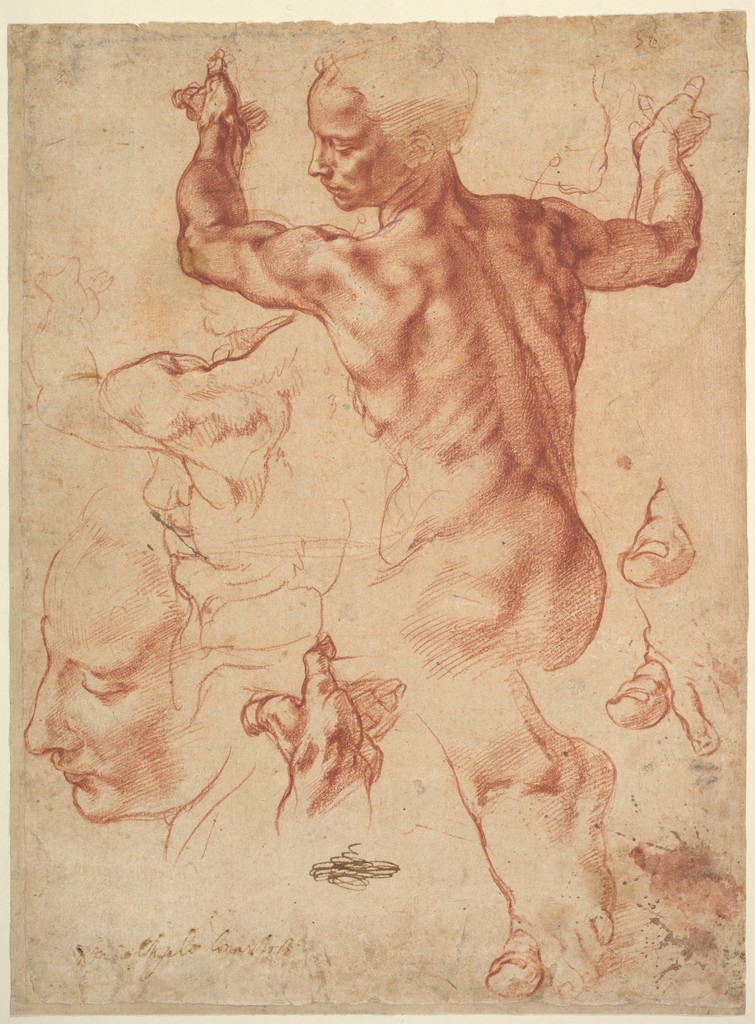
Look at *David* (1501-04) and what the marble does is not anatomy. The young man stands seventeen feet tall with his slingshot over a shoulder and his right hand oversized at his side, and the head is turned just enough to be looking at something the viewer cannot see. The pose is calm; the body is calm; the calm is what makes the figure a theological proposition — a body waiting for what it has decided to do. Look up at the Sistine ceiling (1508-12) and the same painter who carved the David made nine ceiling panels and hundreds of subsidiary figures in which every part of the Christian story from the creation to the flood is told through bodies in twist and weight. There is no architecture without bodies; there is no sky without bodies; the bodies are doing the work the doctrine usually asks of words.
Then, late in life — the *Pietà* at Rondanini, unfinished at his death in 1564 — the same hand carves a mother and a dead son so closely fused they are nearly one column of stone, the chisel marks still visible, the figures barely able to stand. On the consumed-observation to commissioned-devotion axis the Artist Studies arc reads through, Michelangelo is the case where commissioned devotion goes so deep it is nearly indistinguishable from liturgical work. Pope Julius II paid for *David*; Pope Sixtus IV's nephew paid for the ceiling; Pope Paul III paid for the *Last Judgment*. None of those payments produced what Michelangelo produced. He worked for the patrons and far past them. Vela reads him for the figure as the carrying instrument of religious argument, and for what it looks like when a single artist treats the body as something close to sacrament.
Character
Works in the library
Collected at
In the magazine
Read alongside
- Donatello
The Florentine generation before Michelangelo whose bronze and marble figures — the David, the Magdalene, the Cantoria — established that a Renaissance body could carry weight Christian art had previously given to gesture and emblem.
- Sandro Botticelli
Michelangelo's near-contemporary in Florence, working the line where Michelangelo worked the volume. Read them together for two answers to what the Renaissance figure could be made to do.
- Ludovico Carracci
A generation after Michelangelo, the Bolognese Carracci circle worked openly from his figures while pulling the body back toward an emotional register Michelangelo had not stayed in. The reception history is part of the reading.
Through another lens
- AweEmotion
The Sistine ceiling and the *David* are among the few works in the Western tradition that reliably produce the older sense of the word — the body's quiet under something larger. Read awe through Michelangelo and then through what came after.