Warhol · Method 5 of 12
Blotted Line
1950s commercial illustration; bleeds into early fine art
The method
Before the Factory, Warhol was a commercial illustrator in New York, and he was good at it. The blotted-line technique is the method he invented to move faster — but the skip and broken quality of the transferred line is also the first place you see him think in reproduction. Every blotted line is already a copy of itself. The original, on the first sheet, is discarded or kept only as the matrix. The drawing that exists is the one that came off the press. A figurative line drawing made this way has an intimacy the straight pen-drawing loses. The line is slightly less controlled than the hand that drew it, which means the hand has been given a collaborator — the transfer itself. For figure drawing, for studies of the body, this is a more contemplative method than it looks.
Process
Draw in ink on tracing paper. Press the wet line against a second sheet to transfer it. The transferred line skips, breaks, picks up granularity the original pen-stroke did not have. Hand-color with watercolor or aniline dye. Repeat the transfer to produce multiples of the same drawing with different fills — the commercial-illustration precursor to the silkscreen.
Canonical works
- Shoe illustrations for I. Miller (1955–57)
- A Gold Book (1957)
- Wild Raspberries (1959, with Suzie Frankfurt)
The Vela take
The Vela take: every blotted line is already a copy of itself. A more contemplative method for figure drawing than it looks.
Context
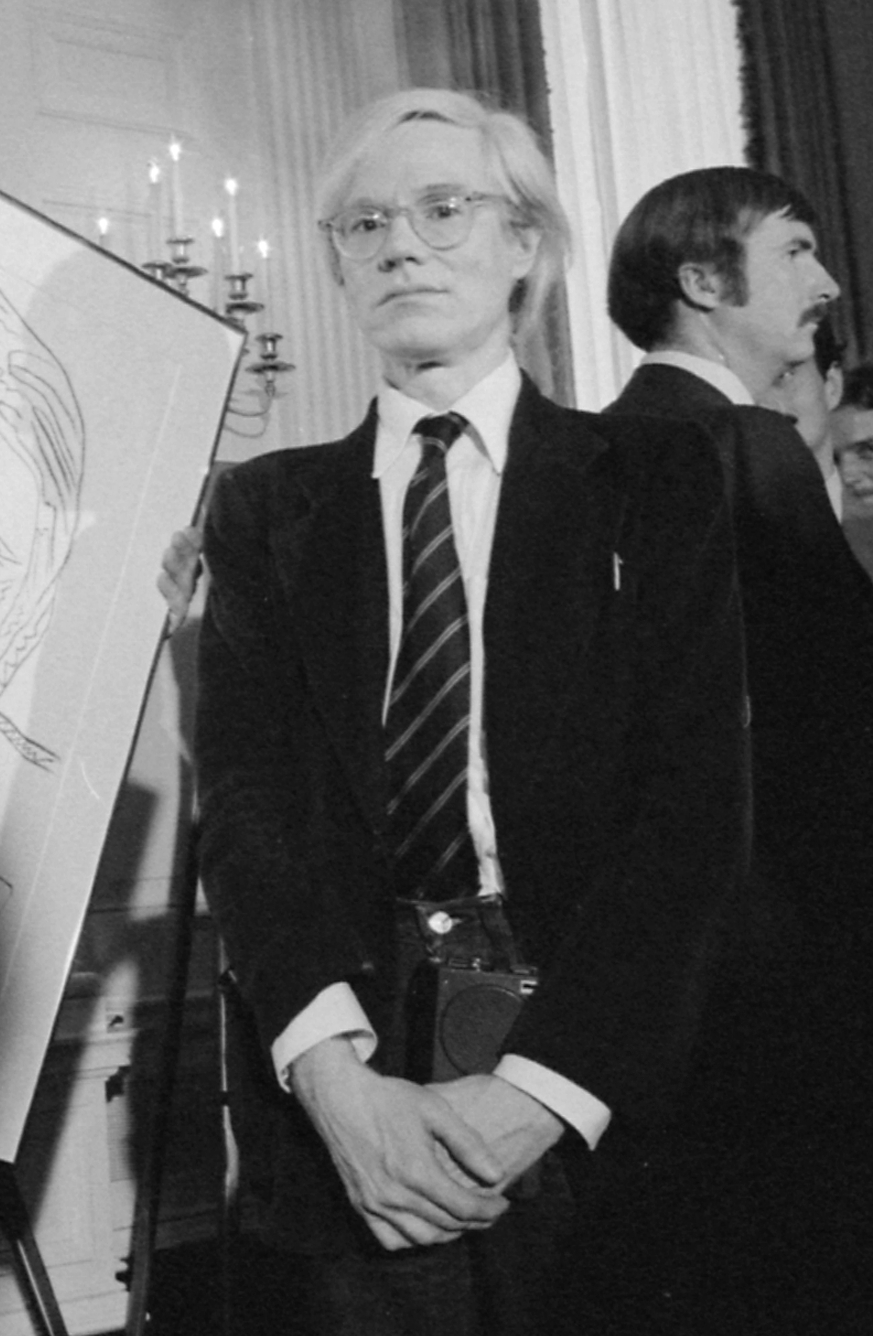
Public domain · Wikimedia Commons
Our reinterpretations
No reinterpretations are live in the library yet for this method. The pipeline is registered in lib/derivatives/treatments/warhol-blotted-line.ts; curator-promoted units will appear here as they ship.