The cynical reading of Andy Warhol is so familiar by now that it has become the first thing the eye reaches for, the way a viewer reaches for a placard before the painting. Warhol was the artist who made fame itself the medium. Warhol was the one who turned the soup can into a sacrament of commerce. Warhol was the man with the silver wig and the tape recorder who claimed, more or less, to have no interior — I'm a deeply superficial person — and who built a studio whose output is still being catalogued forty years after his death.
The cynical reading of Andy Warhol is so familiar by now that it has become the first thing the eye reaches for, the way a viewer reaches for a placard before the painting. Warhol was the artist who made fame itself the medium. Warhol was the one who turned the soup can into a sacrament of commerce. Warhol was the man with the silver wig and the tape recorder who claimed, more or less, to have no interior — I'm a deeply superficial person — and who built a studio whose output is still being catalogued forty years after his death.
The cynical reading is not wrong, exactly. It is just incomplete. What it misses is that almost everything Warhol was accused of — the repetition, the flatness, the refusal to moralize, the collapse of the distinction between the artwork and the image of the artwork — was also the structure of a devotional practice. The soup cans are not ironic. The Marilyns are not ironic. The Shadows are the least ironic paintings of the twentieth century. What looked, to the critics of 1962, like the end of seriousness turns out, sixty years later, to have been a new form of it. Warhol was engaged in a kind of contemplation, and the work is what that contemplation leaves behind.
This is an essay about what the contemplation was for. It is also an essay about what a platform like Vela — a fine art figurative publication that believes sustained attention to the body is a practice that changes the person doing it — can learn from Warhol, and what such a platform has to decline. The two are not easily separated. Warhol invented or perfected several of the methods a contemplative platform most wants to use. He also built, more or less single-handedly, the cultural machinery we are now trying to operate inside of without becoming it. You cannot take one without negotiating with the other.
The thing repetition was actually doing
Begin with the silkscreens, because everyone else does. The Marilyn Diptych was made in the weeks after her death in August 1962. Fifty images of her face, arranged in a grid: twenty-five on the left in color, twenty-five on the right in black and white, the right-hand side progressively bleaching out as the ink starves, until the last Marilyns are barely legible as a face at all. The source photograph — a publicity still from Niagara, 1953 — appears forty-nine more times after its first appearance, each pull of the screen slightly different from the last.
The first thing to say about this painting is that it was not a comment on celebrity. It was a funeral.
The second thing to say is that a funeral, in the form the Diptych takes, is something a culture used to know how to perform and has mostly forgotten. When a medieval saint died, the icon of that saint was reproduced — on panels, on church walls, in prayer books, on pilgrim badges — until the image of the saint was everywhere the saint herself could no longer be. The reproduction was the grief. It was also the love. It was the refusal of the community to accept that the face they had oriented themselves toward was gone.
Warhol, raised in a Byzantine Catholic home in Pittsburgh, knew this. He went to church every week, more or less, for most of his life. He once told a friend that he liked Saint Patrick's Cathedral because the candles were "like the candles in my own apartment, but with more light." The line is almost unbearable when you sit with it. What the silkscreens are doing — what the serialization was for — is what devotional images have always done. They hold the face of the beloved in the only place a surviving community can keep it, which is in the reproduction.
The mistake of the 1962 criticism was to assume that repetition empties an image out. The opposite is true. Repetition is how an image becomes something you can live inside of. The Marilyn you have looked at one time is a picture of a woman. The Marilyn you have looked at forty-nine times is something else — it is the residue of having looked, and the looking itself becomes the subject. The painting does not deliver Marilyn. It delivers the attention you have given to her, back to you, transformed into a texture you can feel.
This is not a cynical proposition. It is a sacred one, thinly disguised. The disguise is what allowed it into the Leo Castelli Gallery in 1962.
Celebrity as figurative subject
Here is the move that is easiest to miss, and therefore most worth pausing on. Warhol did not, as the received view has it, replace the nude with the celebrity. He discovered that the celebrity was, in the middle of the twentieth century, the nude. She was the publicly available body. She was the figure the culture had agreed to look at.
The Western figurative tradition, from Giorgione's Sleeping Venus through Manet's Olympia, rested on a specific consensus: the female nude was the image through which a society worked out its relationship to desire, to vulnerability, to the body as a thing another person could look at. By 1962 that consensus had broken. Manet had already put the courtesan on the bed and ended the pastoral alibi. The photograph had done the rest. By the time Warhol picked up a silkscreen, the nude in the classical sense was an art-historical category, not a living practice. The body the culture was actually staring at was the body on the magazine cover.
Warhol treated Marilyn Monroe the way Titian treated Venus. Not as an opportunity for moral commentary. As the given — the figure the culture had arranged to be looked at — and then asked the question a serious figurative painter always asks: what happens to a body when it is the one everyone is looking at? What does the looking do to it? What is left of the person inside the image after the image has done its work?
The answers Warhol's paintings offer are not reassuring. Marilyn, in the Diptych, is being looked at into extinction. The image on the left is alive; the image on the right is disappearing; between them is the operation that moved her from one state to the other, which is the attention that killed her. Jackie Kennedy, in the Eight Jackies and the Sixteen Jackies, is being made into a face that the national trauma can use. Elizabeth Taylor, in the Liz portraits, is being color-blocked into the arrangement of features the public wants from her — the red lip, the black brow, the pink skin — until what's left is less a portrait than a registration of the emotional temperature of the viewer.
What Warhol was doing with these women — and we must say women first and celebrities second, because the gendered dimension of this work has been systematically understated — is figurative work in the Western tradition, updated for the condition of the image in the postwar period. He was painting the bodies the culture had collectively agreed to look at, and he was painting them with enough attention that the cost of the looking became visible in the paint.
A contemplative platform takes this inheritance seriously. The method Warhol developed, stripped of its specific subjects, is the method figurative work has to have now. You cannot paint the Venus anymore — the pastoral alibi is gone. What you can do is take the bodies the culture is actually looking at, give them the kind of attention the tradition reserved for the nude, and let the accumulated looking become part of what the painting shows. This is not Warhol's method as ironic appropriation. It is Warhol's method as sustained address. It is what figurative work has to do when the classical frame has dissolved.
The Factory as curatorial operating system
The studio Warhol moved into at 231 East 47th Street in January 1964 was painted silver. The walls, the ceiling, the pipes, the window frames. The space itself was a continuous surface. Over the next several years it became, by turns, a printmaking studio, a film set, a performance venue, a rehearsal room for the Velvet Underground, a hangout, a salon, a place where people without an address could sleep, and an assembly line for paintings signed Andy Warhol that Warhol himself did not always physically touch.
This was not a lapse of seriousness. It was the seriousness.
What Warhol built at the Factory — and then rebuilt, in altered form, at the Decker Building in Union Square after 1968 — was the first working model of something for which the art world did not yet have a name. It was a curatorial operating system. It was a studio whose output was not a single artist's hand but a specific kind of attention, organized by one person, executed by many, and legible in the finished work as that organization rather than as individual authorship.
The people who worked at the Factory — Gerard Malanga pulling screens, Billy Name installing the silver foil, Brigid Berlin running the telephone, Fred Hughes handling the business, Jed Johnson later taking the photographs — were not assistants in the conventional studio sense. They were the apparatus. Warhol understood something that would not be widely understood until the 1990s: that a certain kind of artistic practice had outgrown the single-author model, and that the artist's job, at this scale, was to build and maintain the operating system inside which the work could be produced.
This is recognizable now. It is the structure every large studio practice, every digital art project, every contemporary curatorial organization has been reinventing more or less unselfconsciously ever since. What is not often said is how much of the structure was Warhol's invention and how explicitly he theorized it. He talked about himself as a brand — not in the reductive sense the next generation used the word, but in the older sense, as an organized signature under which work of a specific temperament could be produced by many hands.
A platform like Vela is, at its core, a curatorial operating system. It organizes the attention of the reader toward certain images and not others; it builds sequences; it decides what to include and what to decline; it uses one editorial voice across many pieces of content that are in fact produced by many hands, human and otherwise. The Factory is the precursor. It is the proof that such a practice can be made to work at scale without collapsing into mere brand management, and it is also — we should be honest — the place where the danger of such a collapse became visible for the first time.
The shadow side of the Factory is real and should not be minimized. People were hurt there. Some of them never recovered. Warhol presided over a scene whose emotional economics he chose not to manage, and the people he drew in paid for that choice. This is part of the inheritance too. If you are going to build a curatorial operating system, you are going to be responsible for the people who come inside it. The Factory is the cautionary tale embedded inside the founding document.
What the platform inherits, and what it refuses
The Warhol inheritance, for a platform that takes contemplation of the body seriously, comes down to four methods and one refusal.
The first method is serial attention. Repetition, as Warhol practiced it, is not the enemy of presence. It is the way presence gets produced when the image has already entered mass circulation. A platform that shows you the same figure from six angles across six sequences, letting the accumulated looking become part of what the figure means, is doing what the Marilyn Diptych did. The serial form is the contemplative form for an image culture. Vela inherits this directly.
The second method is color as attention-direction. The Liz portraits are not realistic. The lips are too red, the eye shadow is too green, the hair is too yellow. What the color is doing, in a Warhol portrait, is telling you where the attention of the painting wants you to rest. Red is the mouth. Green is the gaze. Yellow is the frame. A contemplative platform — especially one that works with the figure — has to make these decisions constantly. Which element of the body does this piece want the viewer to attend to? What is loud? What is quiet? The Warhol method makes these decisions visible instead of hiding them behind a show of photographic neutrality.
The third method is the Shadows discipline. Between 1978 and 1979 Warhol produced one hundred and two canvases of the same unidentified shadow, silkscreened in seventeen different colors, installed edge-to-edge in a room so the viewer walks a circuit inside them. There is no figure. There is no celebrity. There is no commodity. There is only the time it takes to walk around the installation, and the shift in register that happens somewhere around the thirtieth canvas, when the shadow has stopped being the subject and the subject has become the kind of attention the viewer has been slipped into. A platform built to produce contemplation should study Shadows the way a sculptor studies Brancusi. The lesson is not the shape. The lesson is the time.
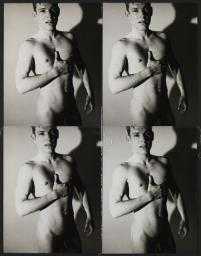
The fourth method is the Polaroid. Before every silkscreen portrait, Warhol took a Polaroid of the sitter with a Big Shot camera at a fixed distance of forty-two inches, using direct on-camera flash. The Polaroid is the intimate object in the practice. It is the moment before the image has been chosen — before the color has been applied, before the silhouette has been locked in, before the face has been decided on. A Warhol Polaroid is a face cornered by an apparatus. Some sitters collapse in front of it. Some ignite. The camera records the difference with an honesty the silkscreen can no longer achieve, because the silkscreen has already made up its mind. The Polaroid is still deciding.
The Polaroid is the most transposable of Warhol's methods. Anyone can stand someone at forty-two inches and press the button. The discipline is what happens in the frame between the person and the apparatus, and the discipline is what the platform inherits — not the equipment, but the honesty about what the instrument does to the body it represents.
These four methods — serial attention, color as direction, the Shadows discipline, Polaroid intimacy — are what a contemplative platform can take from Warhol without reservation. The refusal is more specific and more important.
What Vela declines to carry forward is the corporatization of the image. Warhol, especially after 1968, began to organize his portrait practice around commission from wealthy sitters who could afford to be Warholed. The $25,000 Polaroid, the $40,000 silkscreen, the painted portrait of the CEO or the European aristocrat or the collector's wife: these are not failures of late Warhol so much as a logical extrapolation of an earlier move. If the face is the subject, and the face is also the commodity, then the work will tend, over time, toward faces the market has an appetite for. Warhol understood this and did not resist it. He rationalized it, as he rationalized most things, as a kind of honesty — business art is the step that comes after art — but the rationalization was not convincing in 1979 and it is not convincing now.
A contemplative platform cannot rest on this. The body it attends to cannot be the body the market has already decided to pay attention to. That is the existing arrangement. A platform with any reason to exist has to make some other arrangement. It has to attend to bodies the market is bored by, or has never looked at, or has looked at in the wrong way. It has to make the looking itself the economy, not the body the looking is directed toward. This is a harder business model. It is also the only one that justifies the practice.
The second refusal is the irony economy. By the late 1970s a reading of Warhol had settled in the culture that made him available as camp — the patron saint of cool detachment, the man who proved that nothing needed to mean anything, that surface was all there was. This reading is not Warhol. It is a lowered version of Warhol that the culture found easier to consume than the original. The original Warhol was a devout and frightened Catholic who painted a mother-figure fifty times in the week she died, and who went to mass more or less weekly for forty-five years. The camp Warhol is the one the eighties made out of him because the eighties could not look at the other one.
Vela inherits Warhol. It does not inherit camp Warhol. These are not the same thing. Camp Warhol would be a platform that presents the body with a wink, that hedges every image with a layer of ironic distance, that refuses to let the reader believe the attention is serious. Actual Warhol — the one who made Shadows and stood inside them, the one who signed his name at the bottom of a silkscreen of a face he loved — requires the reader to believe the attention is serious, and the platform to organize itself so that belief is not betrayed.
The death of the aura, revisited
Walter Benjamin — the German Jewish critic and philosopher associated with the Frankfurt School, who killed himself at the French-Spanish border in 1940 while fleeing the Nazis, and whose essay The Work of Art in the Age of Mechanical Reproduction (1935) has been the load-bearing twentieth-century text on what reproduction does to images — wrote, in that essay, that the mechanical reproduction of art was going to destroy the aura of the work. The aura, in his account, was the here-and-now singularity, the accumulated history, the sense that this particular painting has been looked at by specific people at specific times and carries the residue of that looking. Mass reproduction, Benjamin said, would strip this away. It would leave the image intact and the aura behind. The photograph would not have the aura. The print would not have the aura. The copy would circulate, the original would be in storage somewhere, and the viewer would encounter the image without ever standing in its presence.
By the time Warhol took a photograph of a Marilyn publicity still and silkscreened it onto canvas, the process Benjamin described was complete. There was no aura of Marilyn to preserve; the studio had released her image into the commodity economy long before Warhol got to her. What Warhol did — and this is the move that Benjamin's categories cannot quite account for — was take the already-disseminated image and perform an operation on it that was not a preservation of the original aura but the construction of a new one. The Marilyn Diptych has an aura. It is in the Tate. People go to stand in front of it. The object has a history now that the publicity still will never have.
What Warhol proved, in the decades after Benjamin, is that reproduction does not destroy the aura; it relocates it. The aura moves from the original image to the operation performed on the image. The singular moment is no longer when the face was photographed. It is when someone decided to silkscreen the face, in a specific color, forty-nine times, at a specific moment after the subject's death. The operation is the locus of the singular. The ordinary viewer, standing in front of the Diptych, is in fact standing in the aura — not Marilyn's, but Warhol's, and more precisely the aura of the attention that produced this particular treatment of her image.
This matters now, because we are again in a moment when people are arguing that the aura is dying. The argument is about synthetic images. The argument is that when any face can be generated on demand, the specific operation of photographing or painting a specific person loses its weight. The argument is that the aura cannot survive this.
The argument is wrong in the same way it was wrong in 1935 and wrong in 1962. The aura is not destroyed by the proliferation of images. The aura relocates. It moves from the source to the operation, from the original to the editorial judgment, from the singular negative to the singular curatorial act. What matters is not whether the image was generated or photographed or painted. What matters is the attention inside of which the image has been placed, and whether that attention carries enough seriousness to stand around.
A contemplative platform, in this frame, is the operation. It is the aura, relocated. Vela's value is not in the uniqueness of any particular image in its library; it is in the sustained attention the library represents, the accumulated decisions about what belongs inside the frame and what does not. This is the lesson Warhol taught, although the culture is still catching up to it. The question for a platform that takes the body seriously is not whether the image can be copied. The question is whether the attention the platform places around the image is the kind of attention that can be stood around.
Warhol's answer, in his best work, is yes. The Diptych can be stood around. Shadows can be stood around. The Polaroids can be stood around, in the rare rooms where someone has understood what they are. The platform's job is to build the equivalent around its own images — to treat the library as the operation, the attention as the aura, the reader as the one who comes to stand inside of it.
He left us the instructions. He built the first model. He also showed us where the model can fail, which is anywhere it stops being a practice and starts being a business. These are the same building. The visitor has to choose, every time, which one to walk into.
Walk into the practice.
See also: → Warhol at Vela — the gallery hub → Silkscreen Serialization — the method catalog → Polaroid Intimacy — the method catalog → Shadows — the method catalog