Henri Matisse
French · 1869–1954
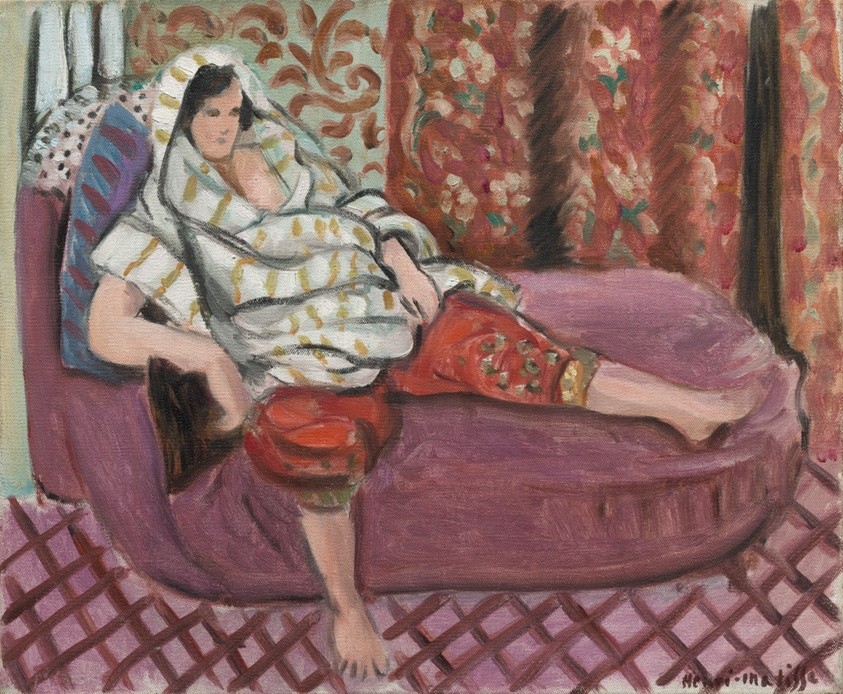
Matisse spent fifty years simplifying. By the time he was cutting shapes out of painted paper from a wheelchair in Nice, he had reduced the figure to a few moves — a curve for a hip, a colour for a room, a line that was also a body. The late work looks easy. It is not. It is the residue of a long argument with the picture.
Look at *The Joy of Life* (1905-06) — a glade of pink and orange nudes lying in pairs and standing in clusters, the figures simplified almost to outline against a flattened landscape. The painting was scandalous in its first season because viewers could not place it; it was neither classical nor caricature, and the colour did not behave the way colour was supposed to. Then jump forty years to *The Snail* (1953) or *Blue Nude II* (1952), and the curve of a hip has become a single piece of cut paper pinned to a wall. The figure has not disappeared — it has been distilled.
On the consumed-observation to commissioned-devotion axis the Artist Studies arc reads through, Matisse sits at the far end of devotion, but the devotion is unusual. It is not to the sitter (most of the late work has no specific model), and it is not to a patron. It is to the surface itself — to colour as a structural element rather than a descriptor of objects, to the painted shape as a thing in its own right. The Chapel of the Rosary at Vence (1948-51), which he called the masterpiece of his old age, is a religious commission he treated as a chance to work the surface at architectural scale: stained glass, line drawing, vestments, all reduced to the same primary moves. Vela reads him for what colour does when figuration is stripped to its essentials, and for the long discipline that distillation actually required.
Character
Works in the library
Collected at
In the magazine
- Why we look awayEssay
Read alongside
- Paul Cezanne
The painter Matisse called 'the father of us all' — the source of the structural use of colour and the patient analysis of form that the early Matisse worked from before he could leave it behind.
- Paul Gauguin
The flat decorative colour and the simplified figure groups of Tahitian Gauguin are visible in *The Joy of Life*; reading them together clarifies what Matisse took and what he immediately recast.
- Vincent van Gogh
Van Gogh's saturated colour and the painter-as-feeling-instrument register set the table for Matisse's generation; the difference between Van Gogh's drive and Matisse's calm is itself a study.
Through another lens
- JoyEmotion
Matisse named the project — *Le Bonheur de Vivre*, *The Joy of Life* — and held to it through war, illness, and the years in the wheelchair. Few painters have made joy a serious working subject for that long.