There is a painting in the Art Institute of Chicago of a woman stepping from a bath. She does not know you are there.
There is a painting in the Art Institute of Chicago of a woman stepping from a bath. She does not know you are there.
This is the defining condition of Degas's bather series — figures absorbed in themselves, oriented away from the viewer, offering the back rather than the face. And something in these paintings produces a quality of attention that the frontal figure, the figure who meets your eyes, rarely achieves.
The question is why.
The psychoanalyst D.W. Winnicott wrote about what he called the capacity to be alone in the presence of another. He meant it as a developmental achievement — the ability to be fully absorbed in your own experience while someone else is in the room. Babies who have had good-enough mothering develop this capacity. Adults who have not spent a lifetime performing for invisible audiences.
What Winnicott described as a psychological achievement, Degas encoded as a formal principle. His bathers are alone in the presence of the viewer. They have the capacity. By granting it to them, he grants a version of it to us.
We are in the room. We are not required to be acknowledged. We can look without announcing ourselves.
A face gives information. A back gives questions.
There is also something simpler at work. A face gives information. A back gives questions.
When a figure meets your eyes, you know immediately what you are looking at — expression, age, mood, intention. The face is a text. You read it and you understand it and you move on.
The turned figure offers no such resolution. You project. You imagine. You fill the absence with your own material. The painting becomes partly yours in a way that the portrait never can be.
This is why certain images hold you longer than others. Not because they are more beautiful, but because they are more open. They have not decided what you will feel. They have left space.
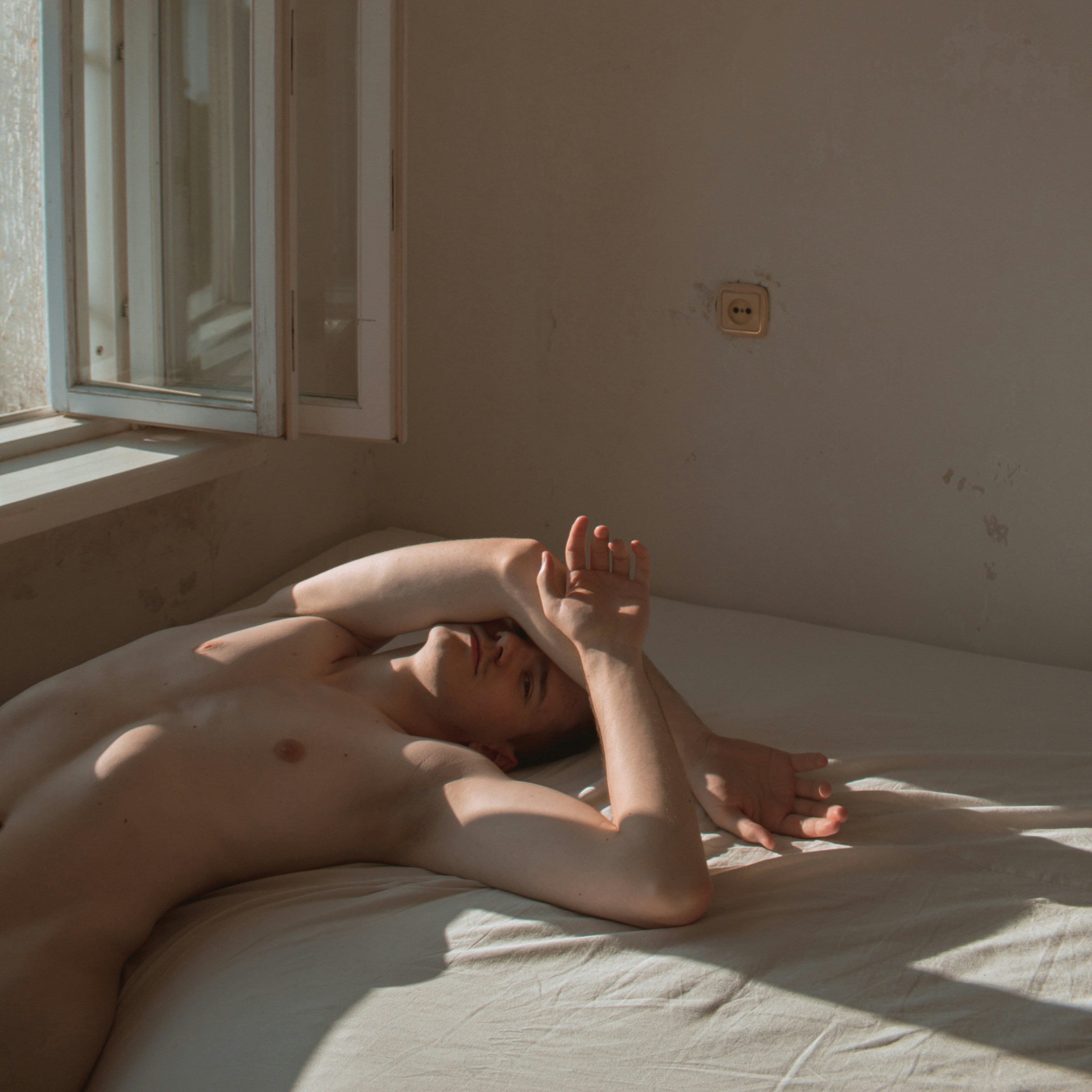
Contemporary photographers working in this tradition — and there are many, though few would name Degas as an influence — produce the same effect through entirely different means. A figure reclining in morning light, face turned toward the pillow. A woman at a window, looking out at something we cannot see. The gesture of attention directed somewhere we cannot follow.
These images share a formal quality with Degas's pastels across more than a century. The conversation the sequence system finds between them — pairing a 19th century bather with a 21st century bedroom — is not coincidence. It is the same question asked twice, in different light, by different hands, about the same irreducible privacy of the absorbed figure.
The turned figure endures because privacy endures. Because there is something in us that recognizes — even welcomes — the relief of not being seen.
Looking at a figure who does not look back is sometimes described as voyeurism, as if the viewer's presence were transgressive. But this misses what is actually happening in the best of these images.
The figure is not unaware of being potentially seen. The condition of being painted — or photographed — is one of consented visibility. What the turned figure enacts is something different: a demonstration that being seen is not the point. That there is an inner life more absorbing than the viewer's attention.
This is the gift the averted gaze gives. It tells you that what you are seeing matters more than who is watching.