Welcome to Vela
Vela is a study of being human — read through three lenses: the body, the emotion, the story.
Vela is not a gallery you scroll through. It is a space you move through slowly, and it learns from the way you move. Every image here depicts the human figure — painted, photographed, sculpted, drawn — and every interaction you have with it becomes part of a conversation between you and the collection. The magazine reads what humans have said about their interiors; the emotion vocabulary is the language by which we name them; the player is where the body's reading speed becomes visible to you. This guide is how to move through it.
A guide to the rooms
The Player
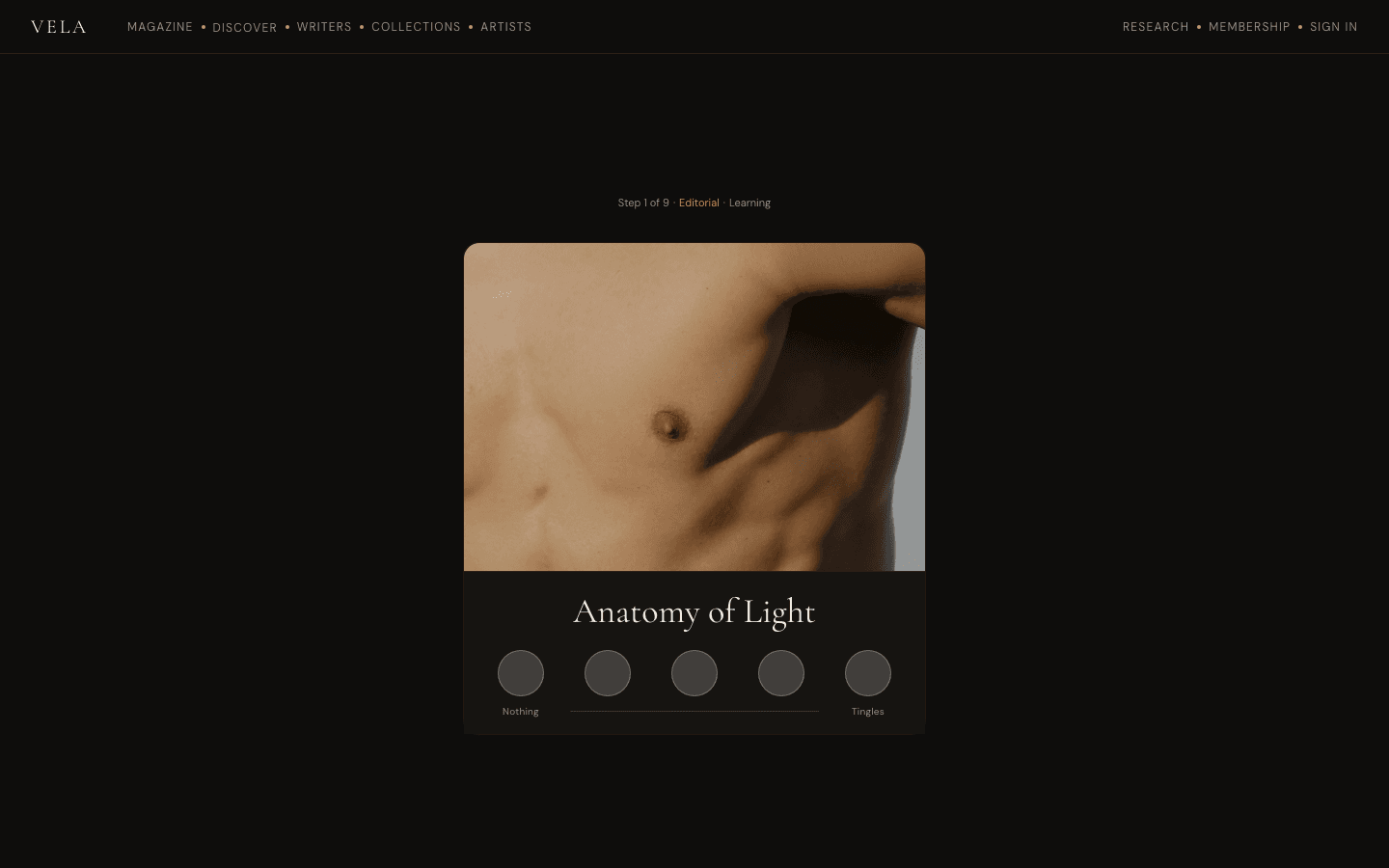
The center of Vela is the player. When you press play, you enter a sequence — a curated conversation between images, arranged so each one shifts what you see in the next.
Below each image is a scale from Nothing to Tingles. One tap records your response and advances to the next work. The scale is there to catch your honest first reaction — the flicker before judgment.
If something stays with you, tap the save icon. Saved works appear in Your Path later.
The player starts in learning mode. During your first sessions, Vela is listening — not to what you say, but to what you linger on, what patterns emerge across your choices. After enough responses, the player shifts to calibrated mode, where sequences begin adapting to your demonstrated sensibility.
Collections
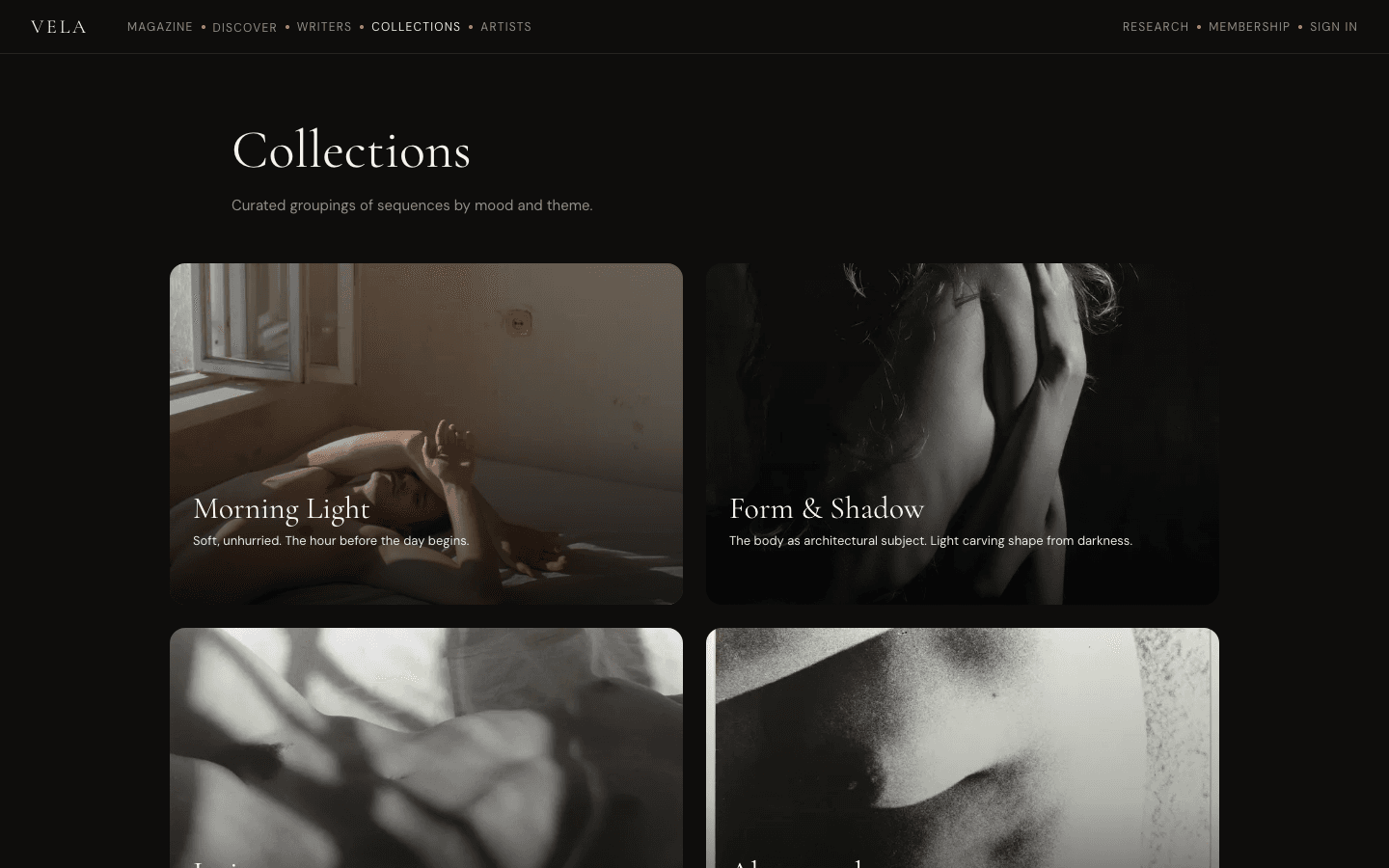
Nine curated collections, each one an editorial thesis about a mood or a mode of seeing. Morning Light gathers images that carry warmth and stillness. Form & Shadow isolates structure and contrast. Intimacy does what the word suggests.
Each collection contains sequences — think of them as chapters. You can browse the collection or play it straight through.
The Magazine
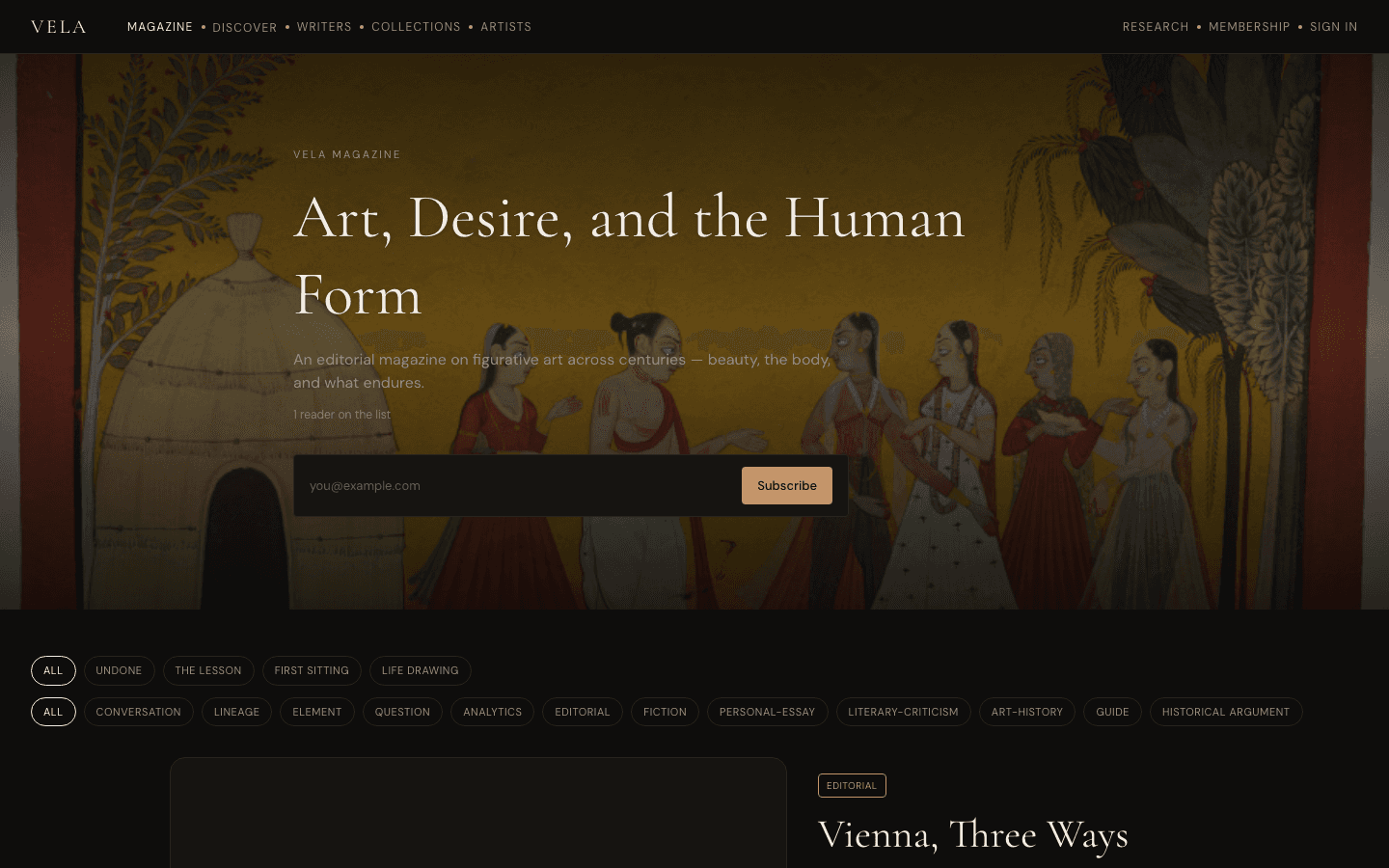
Vela publishes essays and fiction. The essays are about the body in art — how artists across centuries have handled skin, posture, shame, desire, and the viewer's gaze. The fiction is written for Vela, serialized in parts, and gated by membership tier for continuing chapters.
At the end of each essay, logged-in readers can record what they recognized, what they learned, and what they wondered. These responses feed the adaptive system — not to judge your reading, but to understand your intellectual register so the platform can meet you where you are.
Artists
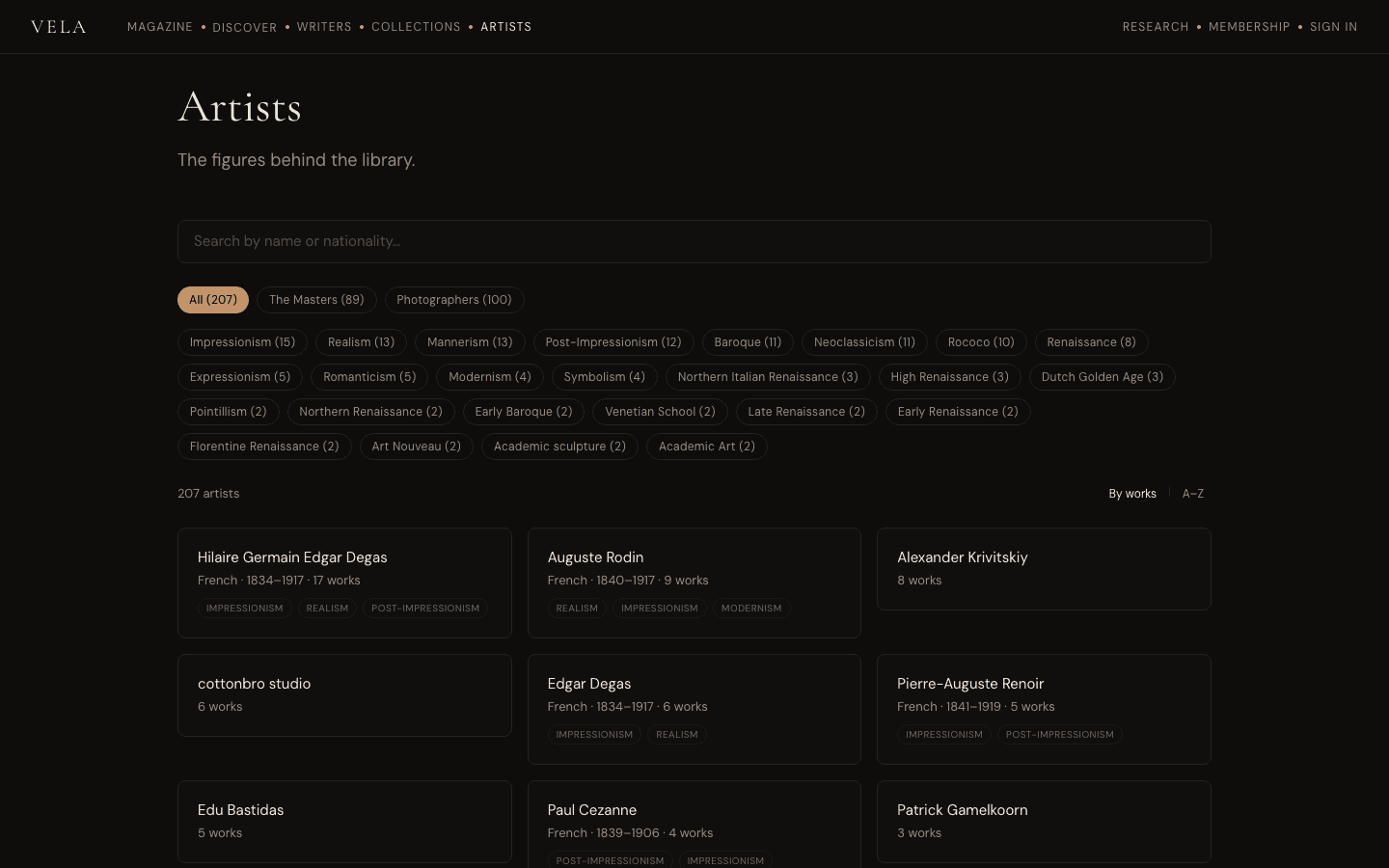
Every work in the library is attributed. The Artists directory collects the creators — painters, photographers, sculptors — with biographical context and links to their works in Vela's collection. Where the source is a museum, the attribution links back to the original institution page.
Your Path
After you have played enough sessions, Your Path begins to populate. This is the platform's understanding of your sensibility, expressed in several forms.
Constellation — a radar chart of your desire profile across eight dimensions: softness, intensity, narrative, structure, texture, abstraction, classical, contemporary. This is not a personality test. It is a mirror.
Desire Letter — a written reflection, generated from your response history, that names what the platform has observed. This is private. It is not shared.
Saved Works — everything you bookmarked in the player, collected in one place.
Museum Pilgrimage — when the collection includes works housed in real museums, Vela can tell you where to find them in person.
Composites
Composites are multi-image grids — two, four, six, or nine works arranged together to create a visual conversation. Some are curated editorially. Some are generated. You can assemble your own from saved works.
A composite is not a mood board. It is an argument made in images.
Styles
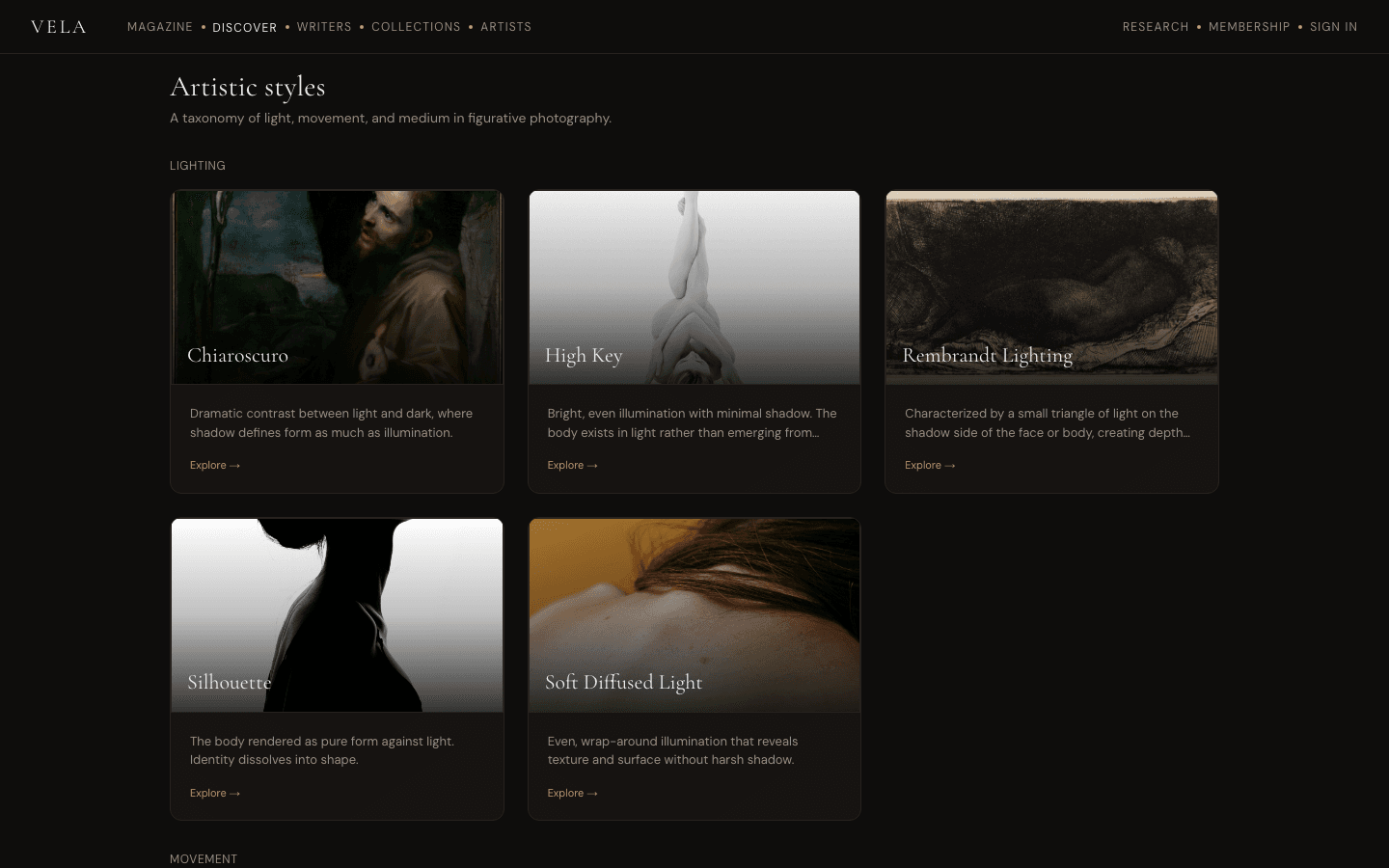
Six visual vocabularies organize the library: editorial soft, cinematic, painterly, fine art classical, minimal line, and abstract form. Each style page includes historical context and representative works. You can explore by style or let the player introduce you to styles you have not seen yet.
A Note on the Rating Scale
The five-point scale is the spine of Vela's intelligence. It is tempting to overthink it. Do not.
Nothing means the image did not land. No judgment on the work — it just did not reach you today. Tingles means something physical happened. The middle is everything in between. The only bad answer is a dishonest one.
Over time, your ratings build a profile that is more nuanced than any questionnaire could produce. The system does not know what you like. It knows how you respond. That distinction matters.
Where to go from here
Open a collection that interests you. Press play. Respond honestly. Save what stays with you. Come back tomorrow.
Vela is not built for a single session. It is built for the accumulation of sessions — for the slow recognition that your sensibility has a shape, and that shape can be named.
Begin