A CONVERSATION
Conversations
The Figure Turned Away
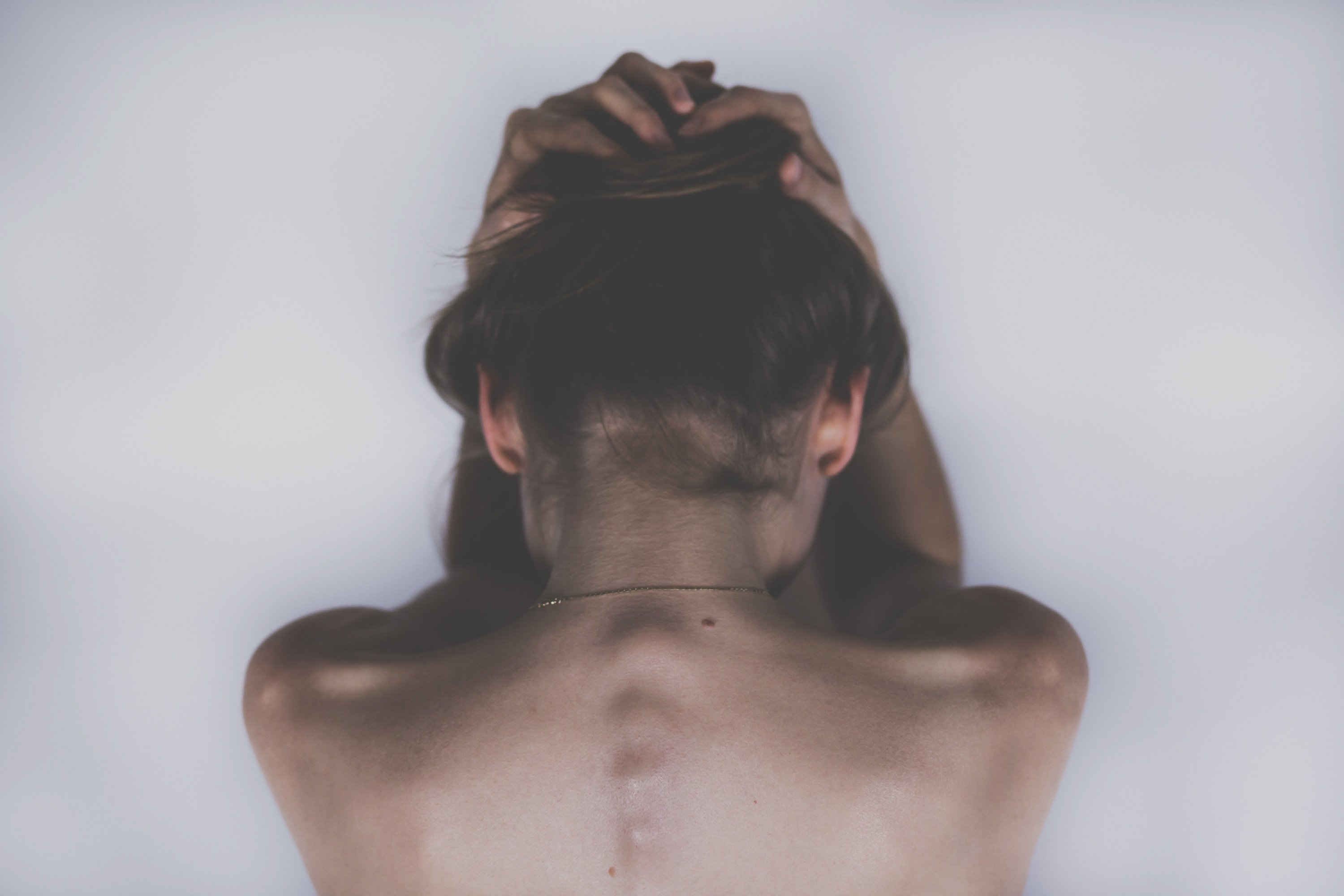
Degas, 1885. A photographer you don't know, 2024. The same morning. What travels across time when everything else changes.
There is a Seurat conté study from the 1880s for Les Poseuses in which a standing nude faces you on the page — frontal and direct, nowhere to hide. This is not a turned back; it is here on purpose, because the essay is about absorption, and absorption takes more than one posture. One hundred and forty years later, a photographer whose name you may not know made an image of a figure in morning light. She is turned away. Also absorbed. Also, entirely, herself.
The history of the human figure in art is largely a history of figures who know they are being looked at. From the Venus de Milo to the Playboy centerfold, the dominant tradition is one of display — bodies arranged for consumption, gazes calibrated to meet yours. This is so normal that we barely notice it. The model looks at the painter. The painter looks at us. We complete the circuit.
Seurat's Poseuses studies include figures who face outward as well as figures who turn aside — the same search for absorption with different orientations.
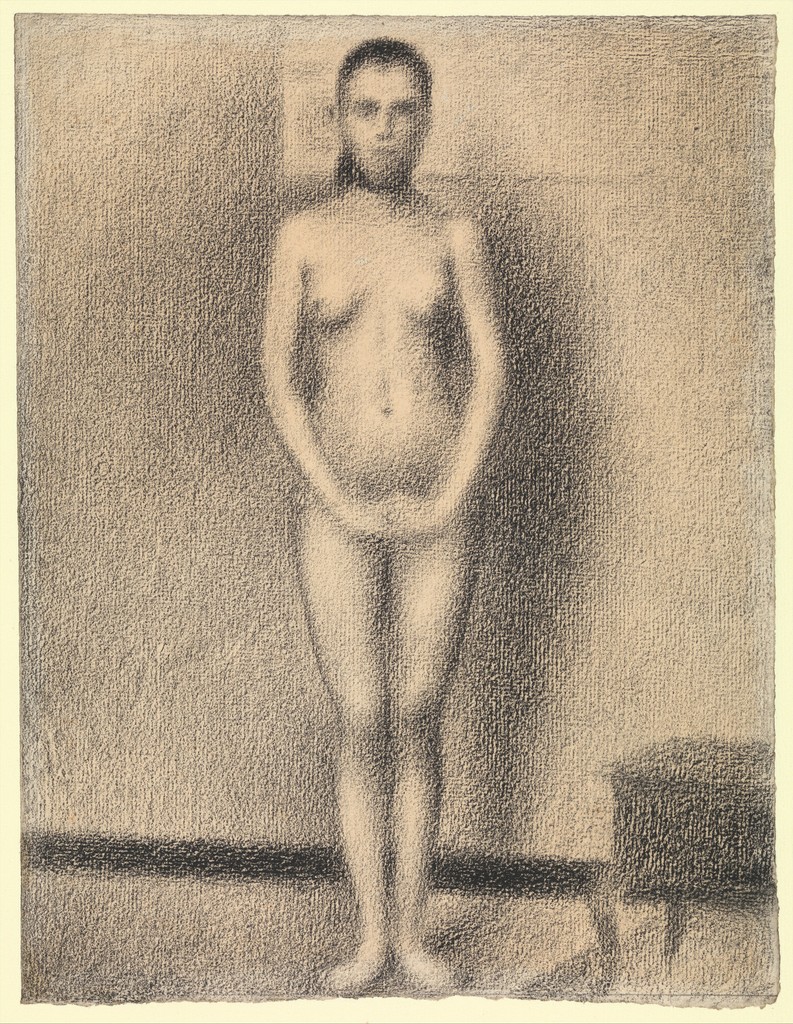
Photo by Georges Seurat on met
The women in Seurat's preparations for Les Poseuses are in the studio — dressing, standing, resting between poses — rendered with the matter-of-fact physicality of people who happen to be in a room together. He was after the figure unperformed — caught in the private act of being a body in the world. He was not interested in beauty as display. He was interested in something harder to name: the dignity of absorption.
The contemporary eye sometimes reads studio nudes as though they were always on display. But look again. The voyeur assumes a subject who would be disturbed if they knew they were watched. These figures would not be disturbed. They would simply continue. They are not hiding. They are just — elsewhere.
He was not interested in beauty as display. He was interested in something harder to name: the dignity of absorption.
This is a tradition. Before the Impressionists there was Vermeer, painting women who read letters and pour milk and have no idea that 350 years from now someone will be staring at them in a museum. Before Vermeer there was Titian, whose reclining Venus stares directly back at you, fully aware of her audience. Titian's Venus is beautiful. Vermeer's women are true. The distinction matters.
— two orientations — both absorbed, a century apart —
Photo by Georges Seurat on met
The contemporary photograph we have placed beside the classical work was not made in conversation with it. The photographer almost certainly did not have the Impressionists in mind. And yet the rhyme holds: not the same orientation — one figure meets the room, the other turns from the camera — but the same absorption, the same quality of light landing on a body that is not performing for your approval.
This is what we mean when we say that certain images are in conversation across time. Not that later artists consciously quote earlier ones — though that happens — but that human experience has a shape, and artists in every century find themselves tracing the same contours. The figure in morning light, absorbed in her own existence. This has been painted, photographed, chalked, and printed thousands of times because it keeps being true.
What makes the averted figure so compelling?
Partly it is the relief of not being met. Most images of the body address you directly — they want something from you, your approval or your desire or your money. The figure turned away wants nothing. You are free to look without obligation. This is rarer than it sounds.
Partly it is the invitation to imagine. A face looking at you gives you information. A back turned to you gives you questions. What is she thinking about? What is the quality of her attention right now? The mind moves into the gap.
And partly — this is the thing that is hardest to say — it is that the turned figure has a kind of integrity. She is not arranged for you. She exists independently of your looking. There is something in that independence that is more beautiful, in the end, than any amount of deliberate display.
The turned figure has a kind of integrity. She is not arranged for you. She exists independently of your looking.
When we built the Minimal Form sequence, we were looking for exactly this quality — works that show the figure without asking the figure to perform. Not all of them are averted. But the best ones share this characteristic: they would be exactly as they are if no one were watching. That is the standard. Not tasteful. Not beautiful. Not even intimate. Just — true to something that does not require an audience.
The painting is over a century old. The photograph beside it was made recently by someone who may not be famous. They have more in common than either has with most of what is produced in between.
That is the thread. That is what we are following.