William Adolphe Bouguereau
French · 1825–1905
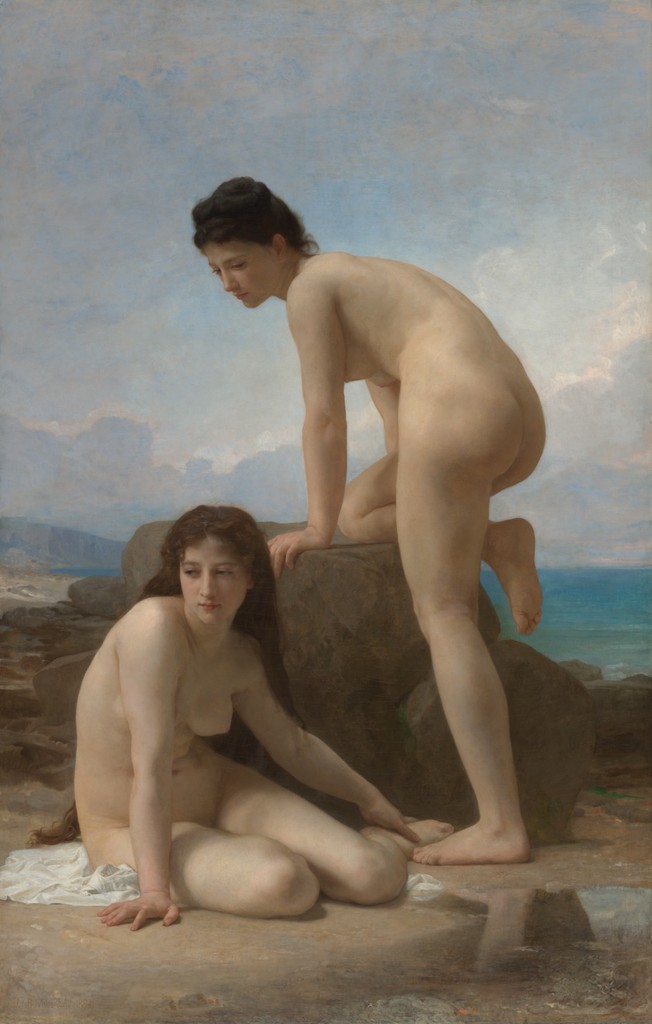
Bouguereau finished the surface. Skin reads as skin, hair holds its own weight, a peasant girl's foot meets the dirt without the painter looking away from either the foot or the dirt. The question his work asks is what so much finish is for — and whether the polish is the point or the cover.
Bouguereau was the most successful painter of his generation and then, for almost a century after his death, the painter critics taught their students to dismiss. Look at *The Birth of Venus* (1879) and the dismissal makes a kind of sense — the goddess is poreless, the sea is theatrical, the cherubs are sweet in a register modern eyes read as kitsch. Then look at *The Nut Gatherers* (1882) or *The Difficult Lesson* (1884), where two ordinary children sit close on a stone, and the finish does something different: it takes the children seriously. The same hand that smoothed Venus into marble gives a peasant girl's bare shoulder the exact temperature of an afternoon.
On the consumed-observation to commissioned-devotion axis the Artist Studies arc reads through, Bouguereau sits unusually — most of his work was *salable* rather than commissioned in the Sargent sense, painted on speculation for collectors who wanted finished beauty and got it. The devotion is to surface and to the academic ideal; the question is whether that devotion is hollow or whether the dismissal was about something else (modernism's need to clear the room, perhaps). Read him for what he taught — Henri Matisse studied with him — and for what he refused to give up when his contemporaries were already breaking the picture plane.
Character
Works in the library
Collected at
In the magazine
Read alongside
- Henri Lehmann
Another French academic painter — Ingres-trained, Salon-formed; read alongside Bouguereau as a fuller picture of what 'academic' meant before the term turned pejorative.
- Peter Paul Rubens
The Baroque source Bouguereau and the entire academy were trained to inherit — the flesh that earned the academic ideal its claim on Venus.
- Gustave Courbet
Bouguereau's near-contemporary and aesthetic opposite — Courbet refused finish on principle. Reading them against each other clarifies what each was for.
Through another lens
- TendernessEmotion
Bouguereau's mother-and-child and sibling pictures are, when the dismissal is set aside, among the most sustained nineteenth-century studies of plain tenderness.