Tradition — Christianity
essays
Augustine, or How the West Learned to Be Ashamed
The bishop who fused shame, desire, and original sin — and what Latin Christianity overwrote to do it
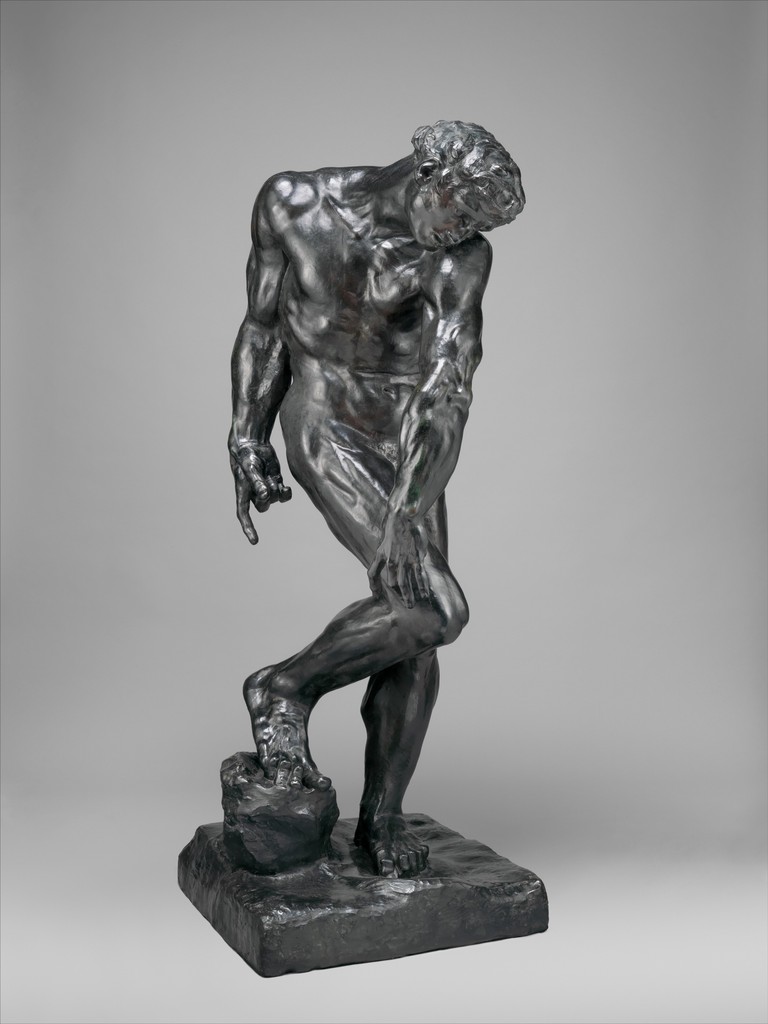
Auguste Rodin·Adam·modeled 1880 or 1881, cast 1910·met
Fair use (educational excerpt)
What Augustine of Hippo actually taught about sex, how his biography and opponents shaped Latin doctrine, and what was lost when the West received him as normative.
It is difficult, at this distance, to say exactly when the West began to confuse desire with shame — to treat the two as synonyms rather than as related but distinct experiences, to sense in any strong current of wanting something the beginning of its own condemnation. The confusion is so general now that it does not look like confusion. It looks like moral seriousness. It looks like the way a person of reflective temperament attends to their own interior.
But it was not always this way, and the tradition that made it this way has a name, a face, a biography, a library, and a rival. The name is Augustine of Hippo. He was born in Roman North Africa in 354, died there in 430 during the Vandal siege of his city, and wrote — by one modern count — the equivalent of a three-hundred-page book every year of his adult life for almost forty years.1 He was a bishop, a rhetorician, a theologian, a heresy-hunter, and for a decade before his conversion a man who lived faithfully with a woman whose name he never recorded in his autobiography and from whose bed he was eventually pulled for reasons of career. His most intimate work is also his most public one. His most systematic is also his most mournful. He was by any measure a genius, and he was also a man in particular pain, and it is load-bearing for the West's subsequent relationship to the body that he was both.
The case this piece wants to make is narrow and precise. It is not that Augustine invented Christian shame about sex — the earliest Christians inherited plenty of ambient Greco-Roman and Hellenistic-Jewish suspicion of the body, and they intensified it considerably under apocalyptic pressure. It is not that Augustine was uniquely disordered in his private life — by the standards of late-antique Roman men, what he did was ordinary. It is certainly not that Augustine was a bad man, or that a person who reads him today is wrong to find him moving. Augustine remains, by a large margin, the most psychologically penetrating writer in the first millennium of Christian thought. His interiority is where the Western self gets much of its shape.
The case is more specific than any of that. It is that Augustine, with a combination of philosophical power and autobiographical honesty that nobody in his tradition could match, took the disparate and contested materials of earlier Christian thought about sex and fused them at high temperature into a single doctrine: that the loss of Eden is registered in the body, that the evidence of it is involuntary sexual arousal, that the transmission of the Fall from generation to generation happens through sexual intercourse, and that the human will is therefore so compromised at its root that nothing short of supernatural grace can rescue it. This doctrine — call it Augustinian concupiscence — did not exist in its final form before him. The Greek East never fully accepted it and does not teach it today. Within the Latin West it was fiercely resisted in his own lifetime by theologians who had read more widely than he had. And yet it became, for a thousand years and then some, the default grammar of the Western Christian conscience.
The record shows how it happened. The record also shows what it overwrote. This is the first of four pillars on the historic shapes of Christian sexual thought; the others will take up Aquinas, Luther, and Paul. It begins with Augustine because almost every quarrel downstream — Aquinas's natural-law architecture, Luther's pro-marriage revolt, the modern Catholic sexual ethic, the Protestant purity movements, the entire anxious vocabulary of shame that secular Westerners still speak without knowing where they got it — begins, in some real sense, in one man's bedroom in the city of Milan in the autumn of 385.
I. The bedroom in Milan
Augustine had come to Milan in 384 to take up a senior imperial teaching post — a rhetoric chair that carried with it access to the court of the young emperor Valentinian II. He was thirty years old, a provincial from Tagaste (now Souk Ahras in Algeria), and he had arrived with his mother Monica, his son Adeodatus, and the woman who had been his partner for something like thirteen years and who was the child's mother. He never names her. The Confessions refer to her only as illa — she, that one — in a narrative where almost everyone else is named.
Monica arranged a marriage for him that year, to a girl of suitable Milanese social standing. The girl was two years below the legal marriage age; there would have to be a wait. The condition of the engagement was that the concubine be dismissed. She was dismissed. Augustine records the event in a single paragraph of book 6 of the Confessions, written more than a decade after the fact, and it is one of the strangest and most telling passages in the history of Western autobiography.
My heart, which clung to her, was broken and wounded and dripped blood. And yet the wound I had received when my former companion was torn from my side was not healed either… But the pain was rather inflamed.2
Two features of this sentence deserve attention. The first is what it tells us about the relationship. Augustine's concubine was not an occasion of casual sexual diversion — the easy reading, and the reading many of Augustine's later admirers adopted to keep his pre-conversion years suitably lurid. She was the woman he had lived with as a spouse, by his own testimony faithfully, for most of his adult life. When she was sent back to North Africa she took a vow never to be with another man. Augustine, in the interval before the marriage he had agreed to, took another woman — a stopgap, he would call her — and it was this second relationship, not the thirteen-year one, that prompted his most anguished self-accusations in the Confessions. The break with the concubine was a grief. The interval filler was the sin.
The second feature is what the sentence tells us about Augustine's understanding of himself. My heart clung to her. The verb is adhaerebat, which carries the force of adhesion, of something that will not come cleanly away. Drops of blood — the metaphor is startling in a text otherwise addressed to God. The thirteen-year partnership had been torn out of him, and what he writes about it, even a decade later, even as a Catholic bishop in full flight from his own erotic history, is that the tearing did not heal.
It is from inside this grief that Augustine is working when he writes the theology of the Fall. This is not a literary-critical flourish. It is the condition of the primary source. Augustine himself, in the Retractations of 426–427, flagged that his theology of marriage had not been settled satisfactorily — "I think that I did not reach a perfect solution of this question," he wrote, near the end of his life.3 The doctrine his successors received as settled he himself left marked as unfinished.
II. The Manichaean decade
Before his conversion Augustine was, for something on the order of a decade, a "hearer" — the outer grade of lay adherent — in the Manichaean religion. This matters, because Manichaeism is the shadow against which the whole of Augustine's subsequent theology positions itself, and also because the charge that would be brought against him by the most able theologian of the next generation, Julian of Eclanum, was that Augustine never fully escaped it.
Manichaeism, founded in the third century by the prophet Mani in Sassanian Persia, taught that the material world is the work of an evil principle in eternal opposition to the good. The spiritual light trapped in matter longs for release. Flesh is not simply fallen; it is, by its nature, a prison for the soul. The full adherents — the "elect" — avoided sexual reproduction, on the ground that procreation further imprisoned spiritual particles in new bodies. The "hearers," Augustine's grade, were permitted marriage but encouraged toward continence.
Augustine abandoned Manichaean cosmology definitively, and spent much of his later career attacking it in print. What he did not — or, his critics will say, could not — abandon was its intuition about sex. The idea that ordinary sexual desire involves something shameful, something that resists the will's proper command, something whose very presence in the body is evidence of disorder, carries forward from his Manichaean years into his catholic theology. The vocabulary changes. The doctrinal frame changes. The intuition does not.
Julian of Eclanum, writing against Augustine in the 410s and 420s — more on him in §IV below — put the charge directly:
Under the mask of Catholic doctrine, you promote the ancient heresy of the Manichaeans. For what else is it to teach that the nature God made is itself evil, that the act by which parents pass on the image of God is the vehicle of corruption, that the desire by which the sexes come together is the enemy of grace?4
Augustine denied the charge — he had to — and he denied it with great technical care. What he affirmed about creation, against the Manichees, is that the good God had made flesh and called it good. What he affirmed about concupiscence, against Julian, is that post-lapsarian sexual desire is not the same as the Edenic desire God installed in Adam. The two claims are difficult to hold together, and whether they can be held together is one of the central disputes in Western theology.
The dispute is not merely theological. It is biographical, and Julian saw it as biographical. He did not accuse Augustine of lying. He accused Augustine of theologizing a private wound — of writing doctrine out of the particular shape of his own disordered erotic history and then requiring the whole Latin church to inherit the shape.
III. What happened in the Garden
The central move in Augustine's mature theology of the body is deceptively simple. He takes the Genesis story — Adam and Eve, the fruit, the fall, the expulsion — and locates the moment of the Fall's entry into the body not in the eating of the fruit but in the shame that follows.
In City of God book 14, written between 413 and 420, Augustine reads the crucial verses as follows. Before the disobedience, Adam and Eve had been naked and unashamed; after the disobedience they knew they were naked and made themselves coverings. Why exactly? Not because of a sudden aesthetic judgment about the body. Because they had suddenly experienced something they had not experienced in the Garden: their own members moving independently of their wills.
The emotion of lust moves our members of their own accord, and in defiance of our will… Sometimes the impulse is an unwelcome intruder, sometimes it abandons the eager lover, and desire cools off in the body while it is at boiling heat in the mind.5
The first involuntary erection, in Augustine's reading of Genesis, is simultaneously the first sign that something has gone wrong and the mechanism by which the wrongness will be transmitted to every subsequent generation. The covering of the genitals with fig leaves — Augustine observes, with deliberate precision, that the Latin word for the loincloth (campestria) was the same word used for the covering Roman athletes wore over their genitals during exercise — is not a gesture of new modesty. It is the first act of the newly divided will. The body has revealed that it will no longer obey, and the rational self covers the place where the disobedience has become visible.6
This reading has consequences. If shame entered the world through the failure of the body to obey the will, then every later instance of involuntary arousal is a small re-enactment of the Fall. The schoolboy's unbidden erection, the married man's midnight tumescence, the woman's flush of desire at an inconvenient moment — each of these is not merely a physical event but a continuing diagnosis of the human condition. The body testifies against the self. The testimony is always, in the broadest sense, the same testimony: you do not command yourself; something else commands you.
Augustine was not naïve about what his reading implied for sex within marriage. He refused to say — against the Manichees, always — that marital intercourse was sinful. But he also refused to say that it was innocent. The best he could manage, and it is a position he developed with increasing precision over the decades, is that marital intercourse is forgivable — venial, from the Latin venia, indulgence toward a fault — so long as the procreative intention is present. Where the intention is procreative, the involuntary element of desire is, so to speak, absorbed by the larger good; where the intention is mere pleasure, the involuntary element stands alone, and the act is sinful even between spouses.
All non-reproductive sex, even heterosexual sex, is abominable; but it is especially abominable in marriage.7
This single sentence from On the Good of Marriage is one of the most load-bearing utterances in Western sexual ethics. Sixteen hundred years later, it is the intellectual skeleton beneath every official Catholic teaching against contraception, against non-vaginal sexual expression within marriage, against the treatment of sex as primarily relational rather than primarily procreative. The Augustinian reasoning runs: if sex is shot through with the disorder of concupiscence, then the only thing that can redeem the act is the good of what it produces. Remove the procreative good and you have stripped the act of its alibi. Non-procreative marital sex is worse than ordinary fornication, because the married couple have less excuse.
⟨S&R⟩ [Sources & Responses panel: Augustine vs. Julian on sex in Eden. Primary: Augustine, City of God 14.21, arguing that in unfallen Eden reproduction would have occurred under perfect volitional control, "without any movement of libido." Scholar: MacCulloch, LTA, on the "comic aspect" of Augustine's speculations about sexual intercourse in Paradise. Counter: Julian of Eclanum, in Augustine's Against Julian 3.13.26, observing that if Christ was fully human and did not experience sexual desire, then Christ is no better than a eunuch — and therefore Augustine's doctrine makes Christ's humanity defective.]
What Julian of Eclanum saw — and what Julian's defeat within the Latin church meant his objection never received the weight it deserved — is that Augustine's theory of Edenic sex produced a kind of reductio. If the sexual desire I feel is evidence of my fallenness, then Christ, to be fully human and fully unfallen, could not have felt sexual desire at all. But a being incapable of sexual desire is not a complete human being. It is a eunuch. The logic of Augustinian concupiscence requires a Christ who is less than fully human. Which is a Christ who cannot save a fully human race.
Augustine's response to Julian on this point is prolonged and evasive. What he does not do is concede. The Latin West inherited the refusal to concede.
IV. What was there before: the tradition Augustine overwrote
It is not possible to understand Augustine without understanding what he defeated. The two figures he displaced most systematically are Origen of Alexandria and Pelagius of Britain. A third, Julian of Eclanum, was a contemporary rival. Together they represent the roads not taken in Latin Christianity.
Origen (c. 185–254) was the towering theologian of the Greek East a century and a half before Augustine was born. He had read everything available in his world — Hebrew scripture in Greek translation, Greek philosophy, the entire Jewish and Christian library of his day — and had written, by one ancient count, over two thousand treatises. His On First Principles, composed in the 220s, is the first systematic theology in the Christian tradition.
On sin, Origen's position was nearly the opposite of Augustine's. Rational beings, for Origen, have absolutely unimpeded free will. They turn from God; this is the root of what the Bible calls sin; God in his providence arranges the material universe as a school in which fallen souls can, over immense spans of time, return to him freely. In the end — Origen believed this, and his belief was what the later Latin West found most intolerable — all rational beings will be restored. Every soul. Every fallen angel. Satan included.
The Greek word for this doctrine is apokatastasis, restoration of all. The Greek-speaking church never fully accepted Origen and condemned him posthumously in 543 and again in 553, but it never produced a full replacement for him either. The Eastern Orthodox tradition to this day does not teach original sin in the Augustinian sense; it teaches ancestral sin — the inheritance of mortality and the disordered condition of a fallen world, but not the inheritance of guilt. Baptized infants are received into grace not to rescue them from hellfire but to initiate them into the life of the Church. The entire theological architecture of the Eastern church rests on anthropological assumptions Augustine rejected.8
Augustine did not read Origen except in fragments. He did not speak Greek at any depth. His knowledge of the Eastern patristic tradition was limited to what had been translated into clumsy Latin by the time of his adulthood, and he did not know — could not have known — Basil the Great, or Gregory of Nyssa, or the Cappadocian theological synthesis that was developing in Asia Minor in the decades after his birth. The sophistication of the Greek East's treatment of sin and the body was simply not accessible to him. It is one of the historical accidents on which Western Christian theology turns that its most consequential theologian was cut off from its most developed tradition.
Pelagius (c. 354–418) was a British monk — probably actually from Ireland or Scotland, in the northern margins of the Empire — who arrived in Rome sometime in the 380s and became, by the 410s, the leading spiritual director of a circle of wealthy lay Christian aristocrats committed to rigorous moral reform. The caricature of Pelagianism that comes down through Augustinian polemic is that Pelagius taught humanity could save itself by its own efforts, without grace. This is not quite what Pelagius said, but the distortion is understandable: what Pelagius did teach, and what drove Augustine to the limits of his polemical powers, was that the human will after Adam is not so corrupted that serious moral effort is impossible. Virtue, for Pelagius, is genuinely achievable. Not easy. Not common. But possible, and therefore demanded.
The conflict between Pelagius and Augustine was not over whether grace is necessary — both said yes — but over whether human nature after the Fall is so broken that unaided choice toward the good is impossible. Augustine said yes. Pelagius said no. Pelagius was condemned at the Council of Carthage in 418 after a prolonged political campaign in which Augustine's influence with the Roman emperor was decisive. His works mostly survive in fragments quoted by his opponents.
Diarmaid MacCulloch — the British church historian, emeritus Professor of the History of the Church at Oxford, whose Christianity: The First Three Thousand Years (2009) and Lower than the Angels: A History of Sex and Christianity (2024) are the standing long-arc histories this arc cites — offers a judgment worth quoting on the Pelagius debate. The received picture — Augustine the generous-minded humane theologian of grace against Pelagius the chilly moralist — is nearly the reverse of the historical reality:
Pelagius was by temperament a puritan, determined to frighten Christians into anxiously examining every deed and thought to check for sin.9
The point is that Pelagian moralism produced an extremely demanding theology of personal responsibility, and that Augustine's doctrine of grace, for all its bleakness about human capacity, produced something like relief: since you cannot save yourself by effort, the burden of perfectionism is lifted. Both theologies generate anxiety. They generate different anxieties. The Augustinian tradition chose one set of anxieties; we still live inside them.
Julian of Eclanum (c. 386–454) was the youngest and most formidable of Augustine's opponents, and he is the one most worth knowing today. He was an Italian aristocrat, trained in Greek (which Augustine was not), bishop of a small Italian see (Aeclanum, near modern Benevento), and he knew Theodore of Mopsuestia personally — the greatest Antiochene theologian of the age, whose work Julian translated from Greek into Latin. When Julian read Augustine's writings on concupiscence and original sin, he saw not only a theological error but the residue of Augustine's Manichaean years, unacknowledged.
Julian's central claims against Augustine are worth stating in their own terms:
- Creation, including sexual desire, is good in itself, not only as a utility ordered to procreation.
- The human Jesus, to be fully human, experienced desire as part of that humanity — and did not sin.
- Pain and mortality were part of the original created order, not punishments for disobedience. Death is not the wages of Adam's sin; death is part of finite creaturely existence as God made it.
- The sin of Adam belongs to Adam, not to his descendants. Children are not born guilty. Guilt is not transmitted biologically.
- Virtue is possible, and the call to it is not cancelled by grace but expressed through grace.
Julian lost. He was deprived of his see in 419, spent the rest of his life in exile, and died obscurely in Sicily in the 450s. Augustine produced six enormous treatises against him and never finished the Opus Imperfectum — the "unfinished work" — he was writing against Julian at the moment of his own death in 430. What survives of Julian is almost entirely the fragments Augustine quoted in order to refute. Read them in order: you can hear, across sixteen hundred years, a voice of astonishing reasonableness, pressing Augustine on exactly the points at which modern readers feel his theology strain.
⟨S&R⟩ [Sources & Responses panel: Augustine vs. Origen on salvation. Primary: Augustine, City of God 21.17, on the necessity of eternal punishment for the damned. Scholar: Fredriksen, SEH Ch. 3, on how Origen's universalism was the road not taken. Counter: Origen, On First Principles I.6.3, "the end is always like the beginning" — meaning all rational beings, even Satan, will eventually be restored to God.]
V. The traducianist insight: how sin became biological
One of Augustine's signature moves, and possibly the single doctrinal innovation with the greatest downstream effect on Western sexual ethics, is the fusion of original sin with human reproduction.
The intuition was not original to Augustine — it was present in a loose form in earlier North African Latin theology, particularly in Tertullian's doctrine of traducianism, which held that the soul is propagated along with the body, generation to generation, rather than being newly created for each individual. Augustine did not fully commit to traducianism as a philosophical proposition; he remained agnostic on the technical question of how exactly soul was transmitted. But what he did commit to, and what his Greek-speaking contemporaries never accepted, was the stronger claim: that the act of procreation itself is the vehicle by which the guilt and disorder of Adam's first disobedience are passed on.
Our nature sinned in him.10
The phrase is natura nostra peccavit — our nature sinned. Augustine's argument is that Adam, as the first human, contained in some real sense the whole future human race; Adam's sin was therefore not only his own but ours, and the transmission of the sin to each subsequent person happens through the way each subsequent person is conceived and born.
This is a remarkable claim. It makes sin not a matter of individual moral failure but a matter of biological inheritance. It explains, in Augustinian terms, why even infants — who have not yet done anything — are not innocent: they carry the Adamic taint through the very act that produced them. It justifies, in Augustine's reasoning, the otherwise horrifying Latin teaching that unbaptized infants who die go to Hell, or (in a late softening) to Limbo, rather than to Heaven.
It also does a specific piece of theological work: it tightens the link between sex and sin to the point where the link becomes ontological rather than moral. Sex does not merely tend to occasion sin. Sex is the mechanism by which sin enters each new human life.
The Eastern tradition, as noted, never accepted this. The Orthodox theologians who engaged Augustine's later works — mostly by way of Latin summary — rejected both the biological transmission of guilt and the doctrine of original sin as Augustine formulated it. The Greek-speaking Christian world teaches, to this day, that Christ rescues humanity from death and from the cosmic condition of the Fall, not from an inherited guilt each person carries from birth. Baptism in the East is therefore theologically differently structured. The infant is received into grace; the infant is not being saved from damnation.
Within the Latin West, the traducianist chain Augustine articulated became so deeply woven into the structure of theological reasoning that it is difficult to isolate. Aquinas refines it with Aristotelian categories but preserves its core. Luther simplifies it and turns it into the justification for infant baptism. Calvin systematizes it further and builds double predestination on top of it. The secular modern West still uses its grammar — in the idea that some people are just "born bad," in the assumption that the sexual act carries some special spiritual weight irreducible to its physical facts, in the persistent popular intuition that desire and shame are somehow the same.
⟨S&R⟩ [Sources & Responses panel: The traducianist chain Augustine crystallized. Primary: Augustine, Against Julian, Opus Imperfectum 3.74, on the massa damnata — the "filthy lump" of fallen humanity. Scholar: Fredriksen, SEH, on how Augustine's massa language recurs obsessively in association with Latin words for loss, sin, and filth. Counter: John Cassian, Conferences 13, writing from the Greek-speaking East into Latin — grace precedes and accompanies human effort, but does not erase human agency; the doctrine that would be called "Semi-Pelagianism" by its later opponents represents the mainstream Eastern view Augustine never successfully silenced in his own lifetime.]
VI. The three goods of marriage
Augustine's constructive theology of marriage, worked out in the paired 401 treatises On the Good of Marriage and On Holy Virginity, rests on a formula so simple and so durable that the Western church taught it for twelve centuries almost without modification. Marriage has three goods: fides, proles, sacramentum. Fidelity, offspring, sacrament.
Fides — faithfulness — meant the mutual obligation of spouses to refrain from sexual relations outside the marriage. This preserved the Pauline "marital debt" (1 Corinthians 7.3–4) but in a weakened form: where Paul had emphasized reciprocal obligation as sexual mutuality, Augustine emphasized it as the boundary around sexual exclusivity.
Proles — offspring — meant the orientation of marital sex toward the generation of children. This was Augustine's way of redeeming an act he otherwise viewed as shot through with concupiscence: if the act is aimed at procreation, the larger good absorbs the disordered pleasure. If it is not aimed at procreation, the disordered pleasure is left without cover.
Sacramentum — which in Augustine's Latin does not yet mean "sacrament" in the later technical sense but carries the etymological force of the oath Roman soldiers swore to the emperor — meant the indissoluble bond. Once contracted, a Christian marriage could not be dissolved. Augustine rejected even the Matthean exception for adultery, on the reading that marriage was as binding as the sacramentum of a military oath.11
The three goods formula did enormous theological work. It made marriage legitimate without making it equal to celibacy — Augustine still held that consecrated virginity was a higher state, as Jerome had taught a generation earlier. It justified ordinary Christian household life against the radical ascetics who claimed that no sexually active person could be a serious disciple of Jesus. And it fused the idea of marriage with the idea of indissolubility so tightly that Western canon law would, for a millennium, regard the bond as unbreakable even when the relationship had collapsed.
What is missing from the formula, and what is worth noting, is the idea of marriage as union, as mutual completion, as the shared growing-up of two persons across the span of a life. Augustine does not deny that such goods exist in marriage. But they do not appear in his formal theology. The three goods are faithfulness, offspring, indissolubility. They are what marriage is for. They are not what marriage, in the lived experience of a couple, is.
This absence would have been deeply consequential by itself; paired with Augustine's theology of concupiscence, it produced a Western tradition that treats sexual love within marriage as tolerated pending the proper outcome rather than as a good in itself. The Eastern tradition, which absorbed Augustine's formula more loosely and preserved Basil the Great's warmer treatment of marriage, never had this problem in quite the same way.12
⟨S&R⟩ [Sources & Responses panel: The fides/proles/sacramentum inheritance. Primary: Augustine, On the Good of Marriage 24. Scholar: MacCulloch, LTA, on Augustine's own late-life acknowledgment in the Retractations that he had not settled this question satisfactorily. Counter: The Orthodox liturgical tradition of crowning in the wedding service, which figures marriage as a shared martyrdom rather than as a hierarchy of goods — a theology of union Augustine's framework never generated.]
VII. What is downstream
The reach of Augustine on the Western sexual imagination is hard to overstate. The clearest way to see it is to trace four tracks:
Catholic sexual ethics. The magisterial teaching on contraception, articulated most recently in Humanae Vitae (1968) but consistent from the Middle Ages onward, rests on the Augustinian-Thomistic premise that non-procreative sexual acts within marriage are gravely disordered because they separate the unitive from the procreative good. The "unitive," in this framework, is a twentieth-century refinement; the procreative requirement is the Augustinian inheritance in its directly transmitted form. When a modern Catholic couple worries whether the use of contraception is a mortal sin, the worry is structured by Augustine's reading of Genesis 3.
The reformed Protestant instinct against marital pleasure. Calvin took Augustine's doctrine of concupiscence and married it to his own emphasis on divine sovereignty. The result was a Protestantism that cautiously affirmed marital sex (Luther did more than this; Calvin was more restrained) but that preserved the instinct that sexual pleasure is spiritually suspect. The Puritan inheritance in the English-speaking world — which is subtler than its caricature but real — carries this forward. The modern American purity movement, which presents itself as a return to biblical roots, is in fact a Calvinist descendant of Augustine, three removes down.
The secular Western association of desire with shame. This is the most diffuse inheritance and also the hardest to argue, because it has long since detached from its theological source. But the phenomenon is observable: the modern Western person who has no formal religious commitment still experiences strong sexual desire as, in some difficult-to-locate sense, a thing to be embarrassed about. The embarrassment is not produced by modern secular ethics, which mostly works in the language of consent and harm. The embarrassment is older than that. It is the residue of the Augustinian doctrine that the will's failure to command the body is the visible sign of the soul's fallenness — translated, under secular pressure, into a vague sense that one's own arousal is beneath one's own dignity.
The problem of the body in Christian worship. Christian liturgical imagination, especially in the Latin West, has had immense difficulty making the body anything other than a problem. Eastern Orthodoxy, with its theology of theōsis (the deification of the body as well as the soul), produced an iconographic and liturgical tradition in which the human body is the site of redemption in a surprisingly integrated way. The West's iconographic tradition, under Augustinian pressure, repeatedly opposes the body to the spirit, produces the recurring theme of the saint tormented by his or her own flesh, and generates a devotional literature — from the desert fathers through the medieval penitentials to certain contemporary Catholic and Evangelical manuals — in which the body is chiefly the occasion of temptation. This is a theological choice. It is not inherent to Christianity. The Eastern church shows what a different choice looks like.
VIII. Reading Augustine now
Two things can be held at once, and the Confessions is the proof that they can. Augustine is a man of extraordinary interior honesty, whose descriptions of the divided will remain — sixteen hundred years later — some of the most penetrating psychological writing in the Western tradition. Grant me chastity and continence; but not yet is still the first thing many intelligent people feel when they think seriously about what they would have to give up to become the person they believe they ought to be.13
And Augustine is the author of a theology that did specific, lasting, observable damage to the Western relationship to the body — damage that the East's refusal of his doctrines allows us to see as damage, because the East is the control group. A Christianity that did not inherit Augustinian concupiscence turned out possible. It is in fact still running, in Greece and Russia and among the Oriental Orthodox. It produced no less sanctity than the West, and considerably less shame.
The question Vela is interested in — the one this arc, as a whole, means to hold open — is not whether Augustine was a great thinker. He was. It is not whether his psychology was acute. It was. It is whether the specific shape his psychology gave to the Latin West's inheritance of Christian sexual thought was the only possible shape, and whether what was lost when the tradition received Augustine as settled doctrine can be recovered.
Julian of Eclanum argued at the time that it was not the only shape, and that the cost of receiving Augustine as settled would be borne by generations of Christians who never heard the counter-argument. Julian lost. The counter-argument survives only in the fragments Augustine preserved in order to refute.
Read Julian in those fragments with a sympathetic ear, and it becomes possible to hear — very faintly, across a great distance — the voice of a tradition in which desire was a good of creation, pleasure was part of Edenic life, pain was coexistent with finitude rather than imported by sin, and the human person, though capable of profound moral failure, was not constituted at birth by a disorder that required supernatural rescue to be overcome.
That tradition is, in a sense, within the Latin canon. It is encoded negatively, as the position Augustine had to argue against. A careful reader can extract it. The extraction is a kind of archaeological work, and it is the work this arc and the column that will follow it have been built to do.
The record shows what Augustine taught. The record also shows what he overwrote. Both parts of the record are the record.
Footnotes
Footnotes
-
Augustine's total literary output is conventionally estimated at around five million words — the equivalent, as Paula Fredriksen calculates, of a 300-page book every year for forty years. Paula Fredriksen, Sin: The Early History of an Idea (Princeton: Princeton University Press, 2012), 11. Cited hereafter as Fredriksen, Sin. ↩
-
Augustine, Confessions 6.15.25. The Latin is more restrained than most English translations convey: cor meum, ubi adhaerebat, concisum et vulneratum mihi erat, et trahebat sanguinem. The standard modern English is Henry Chadwick's Oxford World's Classics translation (1991). The surfacing here follows Fredriksen's attention to the event as autobiographical background for Augustine's later theology, in Fredriksen, Sin, Ch. 3. ↩
-
Augustine, Retractations 2.22. Surfaced in Diarmaid MacCulloch, Lower than the Angels: A History of Sex and Christianity (New York: Viking, 2025), Ch. 9 on "Marriage: Survival and Variety." Cited hereafter as MacCulloch, Lower than the Angels. ↩
-
This paraphrase is consolidated from fragments of Julian's Against Augustine and Ad Florum preserved in Augustine's own Contra Julianum and the unfinished Opus Imperfectum Contra Julianum. For the modern scholarly reconstruction of Julian's positions see MacCulloch, Lower than the Angels, Ch. 9. The direct Latin reconstruction draws on Mathijs Lamberigts, "Julian of Aeclanum: A Plea for a Good Creator," Augustiniana 38 (1988), 5–24. ↩
-
Augustine, City of God 14.16. Translation adapted from Henry Bettenson (Penguin, 1972). The key phrase is motus libidinis, "the motion of lust," which Augustine takes to be the specific form the Fall's damage takes in the body. ↩
-
The campestria observation is MacCulloch's — he notes that Augustine deliberately chose the Latin word associated with the covering Roman athletes wore over their genitals during exercise, rather than any biblical or theological term. MacCulloch, Lower than the Angels, Ch. 9. This is a small but telling example of Augustine's rhetorical precision: he wanted readers to feel the loincloth as an embarrassed covering of newly uncontrollable parts, not as a modest covering of previously indifferent ones. ↩
-
Augustine, On the Good of Marriage 11 (sometimes numbered 10), translation adapted from The Works of Saint Augustine: A Translation for the 21st Century, Part I vol. 9, ed. Boniface Ramsey (New City Press, 1999). Surfaced in MacCulloch, Lower than the Angels, Ch. 13, in the context of the medieval linking of non-reproductive sex with the toleration of prostitution. ↩
-
The Orthodox doctrine of ancestral rather than original sin is not a modern revisionist position but a continuous tradition preserved in the writings of John Chrysostom (late 4th c.), John of Damascus (8th c.), and Gregory Palamas (14th c.). For the continuing contrast with the Augustinian Latin tradition see John Meyendorff, Byzantine Theology: Historical Trends and Doctrinal Themes (Fordham, 1974). ↩
-
MacCulloch, Lower than the Angels, Ch. 9. MacCulloch's broader point is that the popular image of Augustine as the stern theologian opposed by a humane Pelagius is almost exactly backwards — Pelagius was the rigorous moralist; Augustine, for all his bleakness about nature, offered what functioned in practice as psychological relief. ↩
-
natura nostra peccavit. Augustine, Against Julian 4.4.26 and passim. The phrase is a recurring formula across Augustine's anti-Pelagian writings. Surfaced in Fredriksen, Sin, Ch. 3, as the key formulation distinguishing Augustine's position from both Origen's (which accepts no corporate guilt) and the Eastern tradition's (which accepts corporate consequences of Adam's sin but not corporate guilt). ↩
-
Augustine, On the Good of Marriage 7. The etymological point about sacramentum is made explicitly by Augustine in the same treatise. MacCulloch, Lower than the Angels, Ch. 9, notes the historical consequence: Augustine's reading of sacramentum as military oath is how the Western church came to treat marriage as indissoluble in a way the Eastern church, influenced by continuing Roman civil law on marriage, never did. ↩
-
Basil the Great's treatment of remarriage in his canonical letters — which became the basis for Eastern canon law on the subject — allows second and even third marriages under penitential conditions, on the ground that human weakness is real and pastoral flexibility is more faithful to the gospel than rigid indissolubility. See MacCulloch, Lower than the Angels, Ch. 9, on the Basilian alternative. ↩
-
Augustine, Confessions 8.7.17: da mihi castitatem et continentiam, sed noli modo. Fredriksen, Sin, Ch. 3, notes that this is the autobiographical seed of Augustine's mature doctrine of the divided will — the prayer for a good one cannot actually want yet is itself the evidence that the will, after the Fall, is not unified. ↩